<?xml version="1.0" encoding="utf-8"?><feed xmlns="http://www.w3.org/2005/Atom" ><generator uri="https://jekyllrb.com/" version="3.10.0">Jekyll</generator><link href="https://lynettebye.com/feed.xml" rel="self" type="application/atom+xml" /><link href="https://lynettebye.com/" rel="alternate" type="text/html" /><updated>2026-07-20T14:35:45+00:00</updated><id>https://lynettebye.com/feed.xml</id><title type="html">Lynette Bye</title><subtitle>AI journalism, productivity coaching, and research-backed advice.</subtitle><entry><title type="html">You’re enough</title><link href="https://lynettebye.com/blog/2025/8/26/youre-enough" rel="alternate" type="text/html" title="You’re enough" /><published>2025-08-26T12:09:26+00:00</published><updated>2025-08-26T12:09:26+00:00</updated><id>https://lynettebye.com/blog/2025/8/26/youre-enough</id><content type="html" xml:base="https://lynettebye.com/blog/2025/8/26/youre-enough"><![CDATA[<p>I told someone recently I would respect them if they only worked 40 hours a week, instead of their current 50-60.</p>

<p>What I really meant was stronger than that.</p>

<p>I respect people who do the most impactful work they can — whether they work 70 hours a week because they can, 30 hours so they can be home with their kid, or 15 hours because of illness or burnout.</p>

<p>I admire those who go above and beyond. But I don’t expect that of everyone. Working long hours isn’t required to earn my respect, nor do I think it should be the standard that we hold as a community. I want it to be okay to say “<em>that doesn’t work for me</em>”.</p>

<p>It feels like donations: I admire people who give away 50%, but I don’t expect it. I still deeply respect someone who gives 10% to the most impactful charities.</p>

<p>As a productivity coach I see a lot of ambitious EAs struggling to live up to their own (often unrealistic) expectations. The sense of what they “should” do is sky high, and often unconnected with any reasonable path from where they are now. The unreasonableness is especially stark with people learning to live with a new chronic health condition, as they constantly compare their present capacity with what they could do before.</p>

<p>Personally, I average less than 40 hours due to chronic health issues. Accepting that has been hard. There’s never a clear line between pushing myself and resting enough — but I’m happier and more productive when I balance work with “happiness time,” without beating myself up for needing more rest than others.</p>

<p>I want others to have that same freedom. If setting your own sustainable pace were seen as morally okay, maybe I would see fewer people constantly pushing themselves into unhealthy, unhappy situations. (Of course, accommodations depend on the job and are often a privilege — but that’s a reason it’s hard, not a reason not to try.) I want to support a community where there’s affordances for respecting your sustainable limits.</p>

<p>So, in case you needed someone to give you permission – it’s okay to set a sustainable, happy pace that works for <em>you</em> even if someone else can do more.</p>

<p>Other things – like family, friends, gardening, hobbies that make you happy – are worth valuing, and it’s okay (even good) that your happiness and identity are diversified beyond just your work.</p>

<p>I think I need those things that I care about just for me, not because someone else will metaphorically pat me on the head for doing a good job. I think the world is a better place when I take the time to tend my plants, cuddle my dog, and create beautiful things and spaces.</p>

<p>Additionally, if the world changes and there’s no longer work for me and most other humans, or if I change and can no longer do the work I find meaningful, I still want something important that can thrive in that world. And that means having something I value and love that isn’t about my ability to contribute.</p>

<p>For me, that comes partly from accepting my limits as gracefully as I can, and partly from filling the space around them with the most meaningful bits of self and creativity and connection I can find. So I’ll put in my hours, then rest into something good. And I’m going to treat it like I do donating 10% – it’s admirable to do more, but this is enough. I’m still a good person, and I think you are too.</p>

<p>If this resonated with you, I highly recommend Julia Wise’s excellent pieces <a href="http://www.givinggladly.com/2013/06/cheerfully.html">Cheerfully</a> and <a href="https://forum.effectivealtruism.org/posts/zu28unKfTHoxRWpGn/you-have-more-than-one-goal-and-that-s-fine">You have more than one goal, and that’s fine</a>. And I’m going to mollify my anxious instinct to puts caveats everywhere with one link to the <a href="https://slatestarcodex.com/2014/03/24/should-you-reverse-any-advice-you-hear/">Rule of Equal and Opposite Advice</a>.</p>]]></content><author><name></name></author><summary type="html"><![CDATA[I told someone recently I would respect them if they only worked 40 hours a week, instead of their current 50-60.]]></summary></entry><entry><title type="html">Reduce uncertainty for better decisions, a short rant</title><link href="https://lynettebye.com/blog/2024/7/29/reduce-uncertainty-for-better-decisions-a-short-rant" rel="alternate" type="text/html" title="Reduce uncertainty for better decisions, a short rant" /><published>2024-08-29T10:44:10+00:00</published><updated>2024-08-29T10:44:10+00:00</updated><id>https://lynettebye.com/blog/2024/7/29/reduce-uncertainty-for-better-decisions-a-short-rant</id><content type="html" xml:base="https://lynettebye.com/blog/2024/7/29/reduce-uncertainty-for-better-decisions-a-short-rant"><![CDATA[<p>Like many people, you may be thinking some version of “But I can’t answer my key uncertainties! It would take years to know for sure!”</p>

<p>Well, yes, as a matter of fact. You probably <em>can’t</em> eliminate all of your uncertainties. But that isn’t the point. You’re not trying to achieve certainty. You’re trying to reduce your uncertainty so that you can make better decisions.</p>

<p>I took a class with an unusually eccentric professor during my undergrad. This professor claimed that every possible outcome is equally probable, and hence we can’t make inferences about what is more likely to happen based on what happened in the past. Now, I don’t know if this women literally believed that the sun was equally likely to rise in the east or west tomorrow, but that is the literal interpretation of her stated beliefs.</p>

<p>This stance probably seems ludicrous to you. It certainly did to me. But I think a weaker version of this belief is actually fairly common. The weaker belief is that we can’t be certain, so it isn’t worth trying to get more information.</p>

<p>Not at all! The picture isn’t black and white, but there are still darker and lighter shades of <a href="https://www.lesswrong.com/posts/dLJv2CoRCgeC2mPgj/the-fallacy-of-gray">gray</a>. We have a lot of data that we can use to narrow our guesses about what the outcome of different decision would be - in other words, the probabilities of those outcomes. Even given our uncertainty, it can matter a lot to go from 50% certainty to 80% certainty. So don’t toss up your hands yet.</p>

<p>It might help to think in probabilities. For example, is it 50% or 90% certain that you’ll get that promotion? Or what is the range of options that you’re 90% confident contains the real answer? You can say something is “medium” vs “very” likely to happen, but it’s easier to get confused. How often do “medium” likely things happen? How often do “very” likely things happen? What is the difference, and is it consistent? By the time you get to the end of that train of thought, you’ve already put rough numbers to the words, and those numbers may be easier to check and track.</p>

<p>Relatedly, spending a bit of time improving the accuracy and calibration of your guesses is low hanging fruit for making better decisions. The book How to Measure Anything has a great chapter on calibration training, and the Open Philanthropy project commissioned a calibration training tool you can try out <a href="https://www.clearerthinking.org/single-post/2019/10/16/Practice-making-accurate-predictions-with-our-new-tool">here</a>.</p>

<p>Uncertainty reduction is always proportional to how much you already know. If you know very little, then it is very easy to reduce your uncertainty at least a little bit. For those of you familiar with Bayesian reasoning, reducing your uncertainty is equivalent to updating your prior probabilities.</p>

<p>Similarly, it’s extremely common to find uncertainty aversive. Not knowing exactly what to do may be the single most common cause of procrastination. When you have a big or important decision in front of you, it can feel overwhelming even choosing what exactly you need to decide on.</p>

<p>So start by decomposing your decision. What do you already understand? What smaller steps do you know how to do? Who can you ask about the parts you’re confused by? You already have a lot of information - start there! And it’s not cheating to start with small steps like asking for help if you’re really confused.</p>

<p>Finally, you’ll often have to accept that you’re never going to be entirely sure. Once you’ve removed what uncertainty is worth removing, you need to make a decision despite the remaining uncertainty. You can always gather more or better information. Ultimately decision-making is based on judgment calls. Let’s just make them well-informed judgement calls.</p>]]></content><author><name></name></author><summary type="html"><![CDATA[Like many people, you may be thinking some version of “But I can’t answer my key uncertainties! It would take years to know for sure!”]]></summary></entry><entry><title type="html">My career exploration: Tools for building confidence</title><link href="https://lynettebye.com/blog/2024/7/29/my-career-exploration-tools-for-building-confidence" rel="alternate" type="text/html" title="My career exploration: Tools for building confidence" /><published>2024-07-29T10:35:19+00:00</published><updated>2024-07-29T10:35:19+00:00</updated><id>https://lynettebye.com/blog/2024/7/29/my-career-exploration-tools-for-building-confidence</id><content type="html" xml:base="https://lynettebye.com/blog/2024/7/29/my-career-exploration-tools-for-building-confidence"><![CDATA[<p>I did a major career review during 2023. I’m sharing it now because:</p>

<ol>
  <li>I think it’s a good case study for <a href="/blog/2024/5/2/how-to-make-hard-decisions-and-have-impact">iterated depth decision-making</a> in general and reevaluating your career in particular, and</li>
  <li>I want to let you know about my exciting plans! I’m doing the Tarbell Fellowship for early-career journalists for the next nine months. I’m excited to dive in and see if AI journalism is a good path for me long-term. I’ll still be doing coaching, but my availability will be more limited.</li>
</ol>

<h2 id="background">Background</h2>

<p>I love being a productivity coach. It’s awesome watching my clients grow and accomplish their goals.</p>

<p>But the inherent lack of scalability in 1:1 work frustrated me. There was a nagging voice in the back of my head that kept asking “Is this really the most important thing I can be doing?” This voice grew more pressing as it became increasingly clear artificial intelligence was going to make a big impact on the world, for good or bad.</p>

<p>I tried out a string of couple-month projects. While good, none of them grew into something bigger. I had some ideas but they weren’t things that would easily grow without deliberate effort. (Needing the space to explore these ideas prompted me to try <a href="/blog/2023/4/2/rewriting-my-mindset">CBT for perfectionism</a>.)</p>

<p>I always had this vague impostery feeling around my ideas, like they would just come crashing down at some point if I continued. I wasn’t confident in my decision-making process, so I wasn’t confident in the plans it generated.</p>

<p>So at the beginning of last year, I set out to do a systematic career review. I would sit down, carefully consider my options, seek feedback, and find one I was confident in.</p>

<p>This is the process I used, including the specific tools I used to tackle each of my sticking points.</p>

<h1 id="deciding-which-problem-to-work-on">Deciding Which Problem to Work On</h1>

<p>I’m a big proponent of <a href="/blog/2020/11/16/theory-of-change-as-a-hypothesis">theories of change</a>, and think that the cause I pick to work on heavily influences how much impact I can make. I also need to match my personal fit to specific career opportunities, so it’s harder than “just” determining what the most important cause is and choosing a job working on that.</p>

<p>My solution was to write about what I thought were the most pressing problems in the world. I kept that info in the back of my mind later when brainstorming options and considering theories of change for specific options.</p>

<h2 id="example">Example</h2>

<p>My short answer from Jan 2023:</p>

<p>AI seems like the clear #1 cause area, while most of the other <a href="https://web.archive.org/web/20221225041821/https:/80000hours.org/problem-profiles/">main</a> EA cause areas seem like good second options. The outputs from ChatGPT, Stable Diffusion, Midjourney, etc. make me feel like we’re on the cusp of world transforming AI. AI might not replace humans en masse for years, but they’re already sparking backlash from threatened artists. My guess is that AI seems like one of the top areas to focus on even if I set aside AI x-risk, because AI has so much potential to improve the world if it’s used well (which doesn’t seem likely without a lot of people working together to make it go well). However, alignment still seems like the most important area, because we need alignment both for x-risk and for maximizing the potential for AI.</p>

<p>I don’t have an especially detailed view of what the bottlenecks are in AI safety. (Based on poor past performance trying out coding, I’m not a good candidate for direct technical work.) Generically, [improving the productivity of people working on AI safety] and [helping promising candidates skill up to start working in the field] both seem promising.</p>

<p>Writing for larger audiences on productivity, epistemic/rationality, and EA also seems promising (for AI and other issues), but I feel like my theory of change via outreach is underdeveloped. My likely avenues of impact are increasing productivity for people working in impactful roles, instilling better reasoning skills in readers, and/or spreading EA ideas.</p>

<h2 id="tips-for-you-to-apply">Tips for you to apply</h2>

<p><em>Tool: Write a couple paragraphs about which causes you think are most important and why.</em></p>

<p>Tip: Fortunately, there are some good resources to help locate promising cause areas, like <a href="https://80000hours.org/problem-profiles">80,000 Hours’ Problem Profiles</a>, so you can focus most of your energy on finding the best roles for you within one of them.</p>

<p>Don’t get bogged down here. There’s no single ‘best’ cause area for everyone. Your goal is to identify promising causes where you can find suitable roles. If it helps, I expect you will have more impact in a great role in a good cause area than you would in a poor role in a great cause area.</p>

<p>I call this the “all else not equal” clause. You can’t just make the theoretically best decision as if all else is equal between your options - practical considerations in the real world usually dominate the decision. For example, (for most people) finding out which jobs you can get is more important than theoretically deciding which of your top options would be most impactful if you could get it.</p>

<h1 id="big-brainstorm-of-ideas">Big Brainstorm of Ideas</h1>

<p>I’ve been feeling uncertain partly because it felt like I hadn’t considered all of the options systematically. So I wanted to balance being systematic and practical, since I couldn’t realistically explore a bunch of ideas in depth.</p>

<p>Over the course of a few weeks, I brainstormed around 30 roles and independent project ideas I could explore. (I’ve seen other people make lists with 10-100 options.) I wrote down options I’d already considered and brainstormed more by looking through the 80,000 Hours job board, talking to some close friends, and thinking about potential bottlenecks in the causes I’d listed in my theory of change brainstorm.</p>

<h2 id="example-1">Example</h2>

<p><em>Big brainstorm of work ideas, very roughly grouped by category</em></p>

<ul>
  <li>More measured/outcome-based coaching, working toward specific goals</li>
  <li>Do another impact evaluation</li>
  <li>CBT provider course</li>
  <li>Roleplay training sessions with other peers</li>
  <li>Record calls and analyze them for ways to improve</li>
  <li>Blogging about psych/productivity/ea</li>
  <li>Do a deep dive into expertise</li>
  <li>AI Impacts style research</li>
  <li>Deliberate practice writing skills (e.g. Gladwell exercises, reasoning transparency, rationalist discourse norms)</li>
  <li>Trying to get a job writing for a news source</li>
  <li>Engage a lot with short posts on fb, write a handful of longer posts based on what feels most important/gets traction after doing so</li>
  <li>Write fiction</li>
  <li>Spinning up skilling up courses</li>
  <li>Work with BlueDot</li>
  <li>Help run ARENA</li>
  <li>Intro to bio course</li>
  <li>Research exploration/training course/cohort</li>
  <li>Map the EA landscape talent gaps</li>
  <li>Operations training workshops</li>
  <li>Charity Entrepreneurship</li>
  <li>Take over the MHN</li>
  <li>Do operations for some EA org</li>
  <li>Project manager, e.g. for some AI safety org</li>
  <li>Grant making, e.g. Longview or Open Phil or Founders Pledge</li>
  <li>Do lots of broader social organizing for the London community</li>
  <li>Do retreats/weekends away for community building</li>
  <li>Host workshops or teach at workshops, like ESPER and Spark</li>
  <li>Do productivity workshops</li>
  <li>Host retreats for coaches</li>
  <li>Host retreats for people working on mental health</li>
  <li>Host retreats for people working on rationality</li>
</ul>

<h2 id="tips-for-you-to-apply-1">Tips for you to apply</h2>

<p><em>Tool: Make a list of 10-100 possible career options.</em></p>

<p>Tip: Don’t evaluate your ideas while brainstorming. You will get stalled and think of fewer ideas if you’re thinking about whether they are good or bad as you go. Instead just try to think of as many ideas as possible. Many of these ideas will be bad – that’s fine. You’re just trying to find numerous and novel ideas, so that the top 3-10 are probabilistically more likely to include some really good ideas.</p>

<p>Here are some ways to broaden your options:</p>

<ul>
  <li>Write down any opportunity you already know about which might be very good (e.g. using your capacity for earning to give as a benchmark to try to beat).</li>
  <li>
    <p><a href="https://80000hours.org/job-board/">80,000 Hours job board</a></p>
  </li>
  <li>You can filter jobs by problem area, role type and location.</li>
  <li>
    <p>Also use the job board to discover promising orgs even if they are not currently listing a job you can do right away. See the listed jobs and the ‘Organizations we recommend’ section.</p>
  </li>
  <li>Ask people who share or understand your values what the most valuable opportunities they are aware of are.</li>
  <li>List big problems you have insight into along with possible solutions.</li>
  <li>Look through <a href="https://80000hours.org/career-reviews/">80,000 Hours’ list of promising career paths</a>.</li>
  <li>Look through <a href="https://www.openphilanthropy.org/giving/grants">Open Phil’s grantees</a>, which can be filtered by focus area.</li>
  <li>Don’t forget <a href="https://80000hours.org/articles/career-capital/">career capital</a>. You want to be doing high-impact work within the next few years. To do that you might focus on building skills or other resources in the near term. Everything here applies to this as much as for jumping into a directly valuable role.</li>
</ul>

<p>For those interested, you can read <a href="https://docs.google.com/document/d/1HYa9QES_BUGw3m6gDc8Syac_ih14dl7HqqU3pQ6ncqg/edit">Kit Harris’s list of 50 ideas from a similar brainstorm he did years ago</a>. They span operations, generalist research, technical and strategic AI work, grantmaking, community building, earning to give and cause prioritization research.</p>

<h1 id="quick-ranking">Quick Ranking</h1>

<p>In the past, I’ve found a long list of career ideas overwhelming. This time (based on <a href="https://docs.google.com/document/d/1HYa9QES_BUGw3m6gDc8Syac_ih14dl7HqqU3pQ6ncqg/edit">Kit</a>’s suggestion), I roughly sorted the ideas by how promising they seemed. “Promising” roughly meant [expected impact x how excited I felt about the idea]. Then I selected my top ideas to explore further. This made exploration much more approachable.</p>

<p>I did a quick sanity check by asking my partner if he would have ranked any of the excluded ideas above the ones I prioritized for deeper dives.</p>

<h2 id="tips-for-you-to-apply-2">Tips for you to apply</h2>

<p><em>Tool: Roughly rank your possible career options by how promising they seem.</em></p>

<p>If you have a default option that you can definitely pursue (such as continuing in a job you already have), that’s a good threshold. You can immediately rule out any options that seem less promising than your default.</p>

<h2 id="note-on-using-spreadsheets">Note on using spreadsheets</h2>

<p>I wanted to balance prioritizing quickly and considering ideas I might not have thought about before. After all, I just did a big brainstorm to get new ideas. One way to do this is to put all of the ideas in a spreadsheet and spend a few minutes roughly ranking each one, then see how the averages compare to each other. I quickly did this with a 1-5 scale for personal fit, impact, and skill building potential.</p>

<p>I didn’t personally find this exercise that useful, but I’m still optimistic that <a href="https://www.charityentrepreneurship.com/post/using-a-spreadsheet-to-make-good-decisions-five-examples">spreadsheets</a> can sometimes be helpful for decision making.</p>

<h1 id="project-briefs">Project Briefs</h1>

<p>For each of my top options, I spent thirty min to two hours writing a project brief. (Ones for outside roles were shorter, while independent projects were longer.) This consolidated my understanding of the role/project and helped me identify key uncertainties to test.</p>

<p>The questions from my project briefs were drawn from this <a href="/blog/2020/11/30/questions-for-prioritizing-projects">post</a>. Specifically I answered:</p>

<ul>
  <li>One-paragraph description of the role/plan</li>
  <li>What is the expected impact?</li>
  <li>How much do I expect to enjoy this? How motivated do I feel?</li>
  <li>What hypotheses am I trying to test? What are possible one-month tests of my hypotheses?</li>
  <li>What metrics could I track to address the most likely failure modes with this plan?</li>
</ul>

<p>The project briefs were mostly to identify my key uncertainties. Fleshing out the above questions helped me identify the cruxes that would make me choose or abandon each option, so I could start investigating.</p>

<h2 id="example-2">Example</h2>

<h3 id="scale-up-arena-with-bluedot">Scale up ARENA with BlueDot</h3>

<p><strong>Outline</strong></p>

<p>Work with BlueDot to set up a refined course on their platform and set up training for facilitators to scale the course for potential ML research engineers (using my ideas for a full-time course with dedicated technical facilitators). Ideally, I could then hand the course over to them to run going forward.</p>

<p><strong>Benefit</strong></p>

<p>This course could be used for an accelerated study program where people learn to do ML engineering well enough to get jobs at AI safety orgs. By targeting people who specifically want to work on AI safety, this would help with the bottleneck to AI safety research. (Rohin and other people think this is a bottleneck to safety research.)</p>

<p><strong>Motivation and enjoyment</strong></p>

<p>6/10, need some force to pay attention to all of the details. (I’m excited about the program, but not super excited about running it myself.)</p>

<p><strong>What hypotheses am I trying to test?</strong></p>

<p>That ARENA will accelerate the skilling up process to work at AI safety orgs.</p>

<p>That BlueDot will be able to effectively implement and run this program.</p>

<p>Whether these kinds of programs in general are worth creating and running.</p>

<p>Whether BlueDot in particular is good to work with and whether they are doing high impact work.</p>

<p><strong>What are possible one-month tests of my hypotheses?</strong></p>

<p>Discuss whether Matt and Callum and Rohin think ARENA is promising for skilling up research engineers.</p>

<p>Discuss with Callum and BlueDot whether we should scale up the course.</p>

<p>Try implementing the course on BlueDot’s platform, and run a trial program with their facilitators.</p>

<p><strong>How long will this project take?</strong></p>

<p>Probably 3-10 hours spread out over a couple weeks to figure out if we should try implementing.</p>

<p>Highly uncertain about implementation, maybe range of 20-200 hours? So a couple weeks to 5 months. Worst case scenario is even longer, because it’s all the hours of work plus waiting on other people a bunch.</p>

<p>If we move forward with this project, we definitely need intermediate milestones and reevaluation points. Maybe the first point at whether we attempt it at all. Second one month into implementing – how close are we to opening this to a trial group? Second three months in – is this promising enough that it’s worth going further, if it requires more time than this to implement? Monthly reevaluations after that until running with trial cohort. Third 4 weeks into first trial cohort – is this going well, should we majorly shift course? At end of first trial cohort, how did this go? Is it worth running regularly?</p>

<p><strong>Counterfactual impact</strong></p>

<p>Probably the online course will quietly die unless I push it forward, since Matt isn’t continuing.</p>

<p><strong>Metrics to measure</strong></p>

<p>We don’t know whether the course helps people skill up.</p>

<p>Success rate of participants at getting jobs, how many apply for ea jobs, how many get jobs, how many need to do more study before they’re ready for jobs, how many do something else, we could measure lead of how many want ea jobs and lag of how many get them</p>

<p>How many graduate, how highly they rate the course, also good metrics.</p>

<p><strong>How much would an EA funder be willing to pay me to do this project?</strong></p>

<p>Matt’s program was potentially costing millions and people seemed willing (admittedly that was FTX). Open Phil funded the stipends after FTX, so they thought at least that much met their bar.</p>

<h3 id="personal-blogging">Personal blogging</h3>

<p><strong>Outline</strong></p>

<p>I would continue blogging about psych/productivity/ea/rationality in an attempt to sharpen my own thinking and spread better ideas through the community. I could do some deliberate practice on writing skills (e.g. Gladwell exercises, reasoning transparency, rationalist discourse norms), plus try out my old idea of doing lots of short posts on FB or twitter to refine my understanding of which ideas are most promising for longer posts. Hopefully, those two things would make my writing more useful and compelling.</p>

<p><strong>Benefit</strong></p>

<p>There’s probably something useful in spreading good ideas, and written form is easily spread and scaled. I could reach many times more people than I can in 1:1 coaching, probably including high-impact people.</p>

<p><strong>Motivation and enjoyment</strong></p>

<p>8/10, need some force to follow through on all the exercises and finish posts, but I’m mostly excited about the writing process.</p>

<p><strong>What hypotheses am I trying to test?</strong></p>

<p>Can I write well enough/fast enough that I’m regularly putting out actionable, engaging posts that thousands of people will read?</p>

<p>That my writing will reach a large and/or high impact audience, probably measured by email subscriptions, engagement, and feedback.</p>

<p>That my writing will help the people is reaches, probably measured via self-reports of impact and via engagement.</p>

<p>Whether my FB idea to test engagement works.</p>

<p>Whether I should pursue writing as my main impactful work, including getting a job somewhere with mentorship.</p>

<p>That I can practice and improve the speed/quality of my writing.</p>

<p><strong>What are possible one-month tests of my hypotheses?</strong></p>

<p>Try the FB idea with daily posts for a month, plus at least one blog post.</p>

<p>Read Holden’s post and other materials about the value of journalism (is there an ea forum post about vox FP? 80k post on journalism?) Use these to think about what kinds of messages and audience I want to target.</p>

<p>Ask around for some advice on growing my audience, and implement to see if I can reach a bigger audience (e.g. reposting to hacker news). Measure a bunch of things and see what seems to resonate.</p>

<p>Ask Nuño or someone like Rohin/Kit for estimates of value from posts?</p>

<p>Try out ChatGPT to aid in writing, see if this speeds me up.</p>

<p><strong>How long will this project take?</strong></p>

<p>As much or as little time as I want to give to it. Probably 20+ hours a month if I want to write and read a bunch and publish at least one high quality post a month.</p>

<p>I should have reevaluation points and metrics if I pursue this. Maybe ask for a re-evaluation of donor funding worth after 3 months or 1 year, based on what I produced in that time and how much my audience has grown? Maybe have some metric for how much I should expect my audience to grow? Monthly reevaluations for what I should be doing differently in writing and what to focus on.</p>

<p><strong>Counterfactual impact</strong></p>

<p>There are lots of other writers. None of them are doing exactly what I would be, but maybe I’m not adding that much novel and new?</p>

<p><strong>Metrics to measure</strong></p>

<p>I can imagine I get to the end of a year of blogging, without clearly understanding if this worked. Having specific targets in mind (and ways to measure those targets) for audience growth, engagement, posts published, and donor-evaluated value (or audience? Patron?) could help here.</p>

<p>12 posts published, stretch 24</p>

<p>Audience doubled, to 1000 subscribers (can I measure rss feeds?)</p>

<p>Engagement – I get at least at least one comment on the majority of my posts? Maybe I want substantial comments or people telling me the post was useful for the majority of posts?</p>

<p>Donor-evaluated value – what value would be worth trying this experiment? $200 x number of hours to create a post is a good threshold. Maybe anything that’s higher than the arena course donor value? What value would be worth continuing at the end?</p>

<p><strong>How much would an EA funder be willing to pay me to do this project?</strong></p>

<p>Logan got 80,000 for high variance work on naturalism, with Habyrka expressing expectation that it likely wouldn’t work – this seems relevant but different from what I’m thinking about. Personal blogging is probably below this bar.</p>

<h3 id="guestimate-model">Guestimate model</h3>

<p>I also put together a guestimate model to see if any option was clearly higher impact. While the exercise was helped clarify some uncertainties, it didn’t cause me to update much. Mostly I learned that my confidence intervals were wide and overlapping, so no option was clearly best.</p>

<h2 id="tips-for-you-to-apply-3">Tips for you to apply</h2>

<p><em>Tool: Write a short project brief for each of your top options to identify your key uncertainties.</em></p>

<p>This <a href="/blog/2020/11/30/questions-for-prioritizing-projects">post</a> has many good questions you can consider. I recommend using a <a href="https://www.openphilanthropy.org/reasoning-transparency">reasoning transparency</a>-inspired style if you’re struggling, laying out your reasons and the evidence for those conclusions.</p>

<h1 id="planning-tests">Planning Tests</h1>

<p>In my case, writing the project briefs turned up numerous questions I could investigate. For example, I identified two key uncertainties that would easily change my plans.</p>

<ol>
  <li>Can I write well enough/fast enough for professional journalism or blogging?</li>
  <li>Do I and the other stakeholders want to scale up the ARENA pilot?</li>
</ol>

<p>Additionally, I think there’s often value from just doing as close to the role I want as possible. Do I like it? Am I good at it? Does anything surprise me?</p>

<p>With these in mind, I developed quick tests meant to give me more information about my top options.</p>

<p>My brief explorations included:</p>

<ul>
  <li>Talking to people doing the job</li>
  <li>Reading about the career path (e.g. journalism)</li>
  <li>Talking with potential collaborators</li>
  <li>Applying to a program</li>
  <li>Getting feedback on my plans from people who know me</li>
  <li>Talking with people in the field about how promising a project was</li>
</ul>

<p>My deeper explorations included:</p>

<ul>
  <li>Spending a day at an org I was interested in</li>
  <li>Co-running a ten-week trial program of an AI skilling-up course</li>
  <li>Spending three months blogging regularly</li>
  <li>Taking a relevant course</li>
  <li>Pitching posts to publications</li>
  <li>Applying to the Tarbell Fellowship for journalism</li>
</ul>

<h2 id="example-3">Example</h2>

<p>A couple ideas got dropped because other people took up the mantle. A couple more were directions I could take coaching in, so I had fewer uncertainties. I could learn more from focusing my tests on options where I had less preexisting information.</p>

<p>In the end, I ended up doing the most tests with journalism, which you can read about in this excerpt from my Making Hard Decisions post:</p>

<p>I knew basically nothing about what journalism actually involved day-to-day and I had only a vague theory of change. So my key uncertainties were: What even is journalism? Would journalism be high impact/was there a good <a href="/blog/2020/11/16/theory-of-change-as-a-hypothesis">theory of change</a>? Would I be a good fit for journalism?</p>

<p><em>Cheapest experiments:</em></p>

<p>So I started by doing the quickest, cheapest test I could possibly do: I read 80,000 Hours’ profile on journalism and a few other blog posts about journalism jobs. This was enough to convince me that journalism had a reasonable chance of being impactful.</p>

<p>Meanwhile, EA Global rolled around and I did the second cheapest quick test I could do: I talked to people. I looked up everyone on Swapcard (the profile app EAG uses) who worked in journalism or writing jobs and asked to chat. Here my key uncertainties were: What was the day-to-day life of a journalist like? Would I enjoy it?</p>

<p>I quickly learned about day-to-day life. For example, the differences between staff and freelance journalism jobs, or how writing is only one part of journalism – the ability to interview people and get stories is also important. I also received advice to test personal fit by sending out freelance pitches.</p>

<p><em>Deeper experiment 1:</em></p>

<p>On the personal fit side, one key skill the 80,000 Hours’ profile emphasized was the ability to write quickly. So a new, narrowed key uncertainty was: Can I write fast enough to be a journalist?</p>

<p>So I tried a one-week sprint to draft a blog post each day (I couldn’t), and then a few rounds of <a href="/blog/2023/7/27/diy-deliberate-practice">deliberate</a> practice exercises to improve my writing speed. I learned a bunch about scoping writing projects. (Such as: apparently, I draft short posts faster than I do six-thousand-word research posts. Shocking, I know.)</p>

<p>It was, however, an inconclusive test for journalism fit. I think the differences between blogging and journalism meant I didn’t learn much about personal fit for journalism. In hindsight, if I was optimizing for “going where the data is richest”, I would have planned a test more directly relevant to journalism. For example, picking the headline of a shorter Vox article, trying to draft a post on that topic in a day, and then comparing with the original article.</p>

<p><em>Deeper experiment 2:</em></p>

<p>At this point, I had a better picture of what journalism looked like. My questions had sharpened from “What even is this job?” to “Will I enjoy writing pitches? Will I get positive feedback? Will raising awareness of AI risks still seem impactful after I learn more?”</p>

<p>So I proceeded with a more expensive test: I read up on how to submit freelance pitches and sent some out. In other words, I just tried doing journalism directly. The people I’d spoken with had suggested some resources on submitting pitches, so I read those, brainstormed topics, and drafted up a few pitches. One incredibly kind journalist gave me feedback on them, and I sent the pitches off to the black void of news outlets. Unsurprisingly, I heard nothing back afterwards. Since the response rate for established freelance writers is only around 20%, dead silence wasn’t much feedback.</p>

<p>Instead, I learned that I enjoyed the process and got some good feedback. I also learned that all of my pitch ideas had been written before. Someone, somewhere had a take on my idea already published. The abundance of AI writing undermined my “just raise awareness” theory of change.</p>

<p><em>Deeper experiment 3:</em></p>

<p>Since I was now optimistic I would enjoy some jobs in journalism, my new key uncertainties were: Could I come up with a better, more nuanced theory of change? Could I get pieces published or get a job in journalism?</p>

<p>I applied to the Tarbell Fellowship. This included work tests (i.e. extra personal fit tests), an external evaluation, and a good talk about theories of change, which left me with a few promising routes to impact. (Yes, applying to roles is scary and time consuming! It’s also often a very efficient way to test whether a career path is promising.)</p>

<p><em>Future tests:</em></p>

<p>Now my key uncertainties are about how I’ll do on the job: Will I find it stressful? Will I be able to write and publish pieces I’m excited about? Will I still have a plausible theory of change after deepening my models of AI journalism?</p>

<p>It still feels like I’m plunging into things I’m not fully prepared for. I could spend years practicing writing and avoiding doing anything so scary as scaling down coaching to work at a journalism org – at the cost of dramatically slowing down the rate at which I learn.</p>

<h2 id="tips-for-you-to-apply-4">Tips for you to apply</h2>

<p><em>Tool: Do tests to more deeply investigate your top options, especially your key uncertainties.</em></p>

<p>Start with the cheapest, easiest tests, and work up to deeper tests. I also recommend doing cheap tests of a few things before going deeper with one, especially if you’re early in your career. <a href="/blog/2024/5/2/how-to-make-hard-decisions-and-have-impact">This post</a> has advice and tons of case studies on making career decisions.</p>

<p>You want to address the key uncertainties you identified. Key uncertainties are the questions that make you change your plans. You’re not trying to know everything - you’re trying to make better decisions. This is very important. There are a thousand and one things you could learn, and most of them are irrelevant. You need to focus your attention on the questions that might change your decision.</p>

<p>Spread out asking for advice, roughly from easy to hard to access. So, if you can casually chat with your housemate about a decision, start there! Later when you need feedback on more developed ideas, reach out to the harder to access people, e.g. experts on the topic or more senior people who you don’t want to bother with lots of questions. Some possible questions: Does this seem reasonable to you given what you know? What is most likely to fail? What would you do differently? Here is additional <a href="https://forum.effectivealtruism.org/posts/N3zd4FtGmRnMF7pfM/asking-for-advice">good advice on asking feedback</a> from Michelle Hutchinson.</p>

<h1 id="learning-from-tests">Learning from Tests</h1>

<p>While planning my tests, I realized I needed a system of tracking them. I’d miss important lessons if I didn’t have a reliable method for checking the result afterwards, updating on the new information, and planning the next set of experiments.</p>

<p>So I started using what I called hypothesis-driven loops.</p>

<p>Each week during my weekly planning, I would also plan what data I was collecting to help with career exploration. I wrote down my questions, my plan for collecting data, and what I currently predicted I would find.</p>

<p>All of this made it easier to notice when I was surprised. I was collecting data from recent experiences when it was fresh in my mind. Because I was writing in advance what I guessed I’d find, it was easy to notice when I actually found something quite different.</p>

<p>It allowed me to plan what I wanted to learn from my goals each week, have that in the back of my mind, and reliably circle around the next week to write down any info. This left a written trail documenting the evolution of my plans.</p>

<h2 id="example-4">Example</h2>

<p>Do a 1-week experiment where I draft a new post every day. Hypothesis: ADHD meds will make it easier for me to write quickly and reliably. Drafting a post a day will still be difficult but might be achievable. (80% I’ll be able to work on a new draft each day. 70% I’ll finish at least 2 drafts. 30% I’ll finish all 5.)</p>

<ul>
  <li>I was able to do 4/5 drafts, but got a headache the last day. I finished two of them basically, and have 2 more in progress. Results consistent with ADHD meds making it a lot easier for me to write, though I want to evaluate the posts, test revisions, and check whether this pace is sustainable next week.</li>
</ul>

<p>Talk with Matt and Callum about BlueDot. Hypothesis: It will pass this first test for scalability (65%).</p>

<ul>
  <li>It passed the scalability test, but Callum is going to try exploring himself. I think he’s a better fit than I am, so happy to let him try it out. I’ll reevaluate later if he doesn’t continue or I get new information.</li>
</ul>

<p>Reach out to people/schedule interviews/have interviews/draft post in 1 week: ambitious goal, but seems good to try for my goal of writing faster. 30% I can have a draft by the end of the week. 70% I can do at least 2 interviews.</p>

<ul>
  <li>No draft, but I did six interviews.</li>
</ul>

<h2 id="tips-for-you-to-apply-5">Tips for you to apply</h2>

<p>Set it up somewhere you’ll reliably come back to. The entire point is coming back to update from what you learned, so this exercise is basically useless if you don’t <a href="https://commoncog.com/no-learning-dont-close-loops/">close the loop</a>. I have a todo that I write down the experiments in while doing weekly planning on Saturday, and then I set the due date to be the following Saturday so I’m reminded each week.</p>

<p>State what your plan is for getting information. I tie this into my goals for the week. Usually it looks something like glancing over my goals for the week and seeing if any of my goals are at least partially there to learn from. Then I make hypotheses based on those. This ties together the learning goal with the plan for getting the information.</p>

<h1 id="tracking-probabilities">Tracking Probabilities</h1>

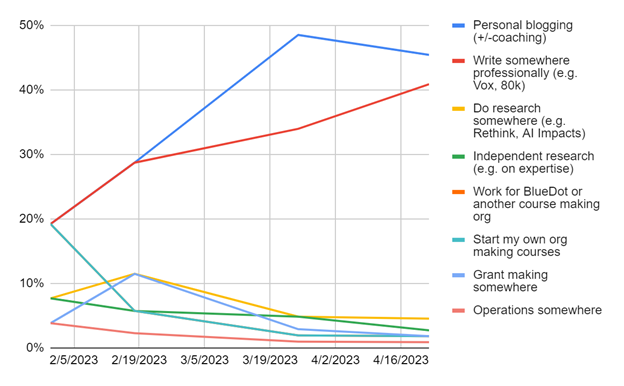
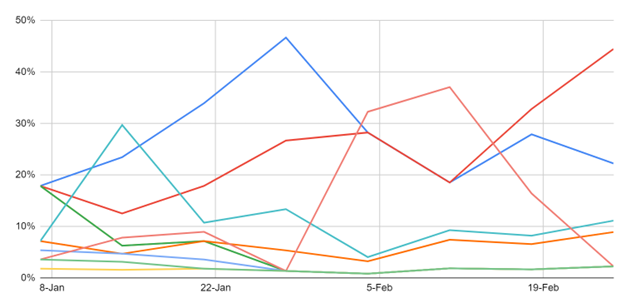
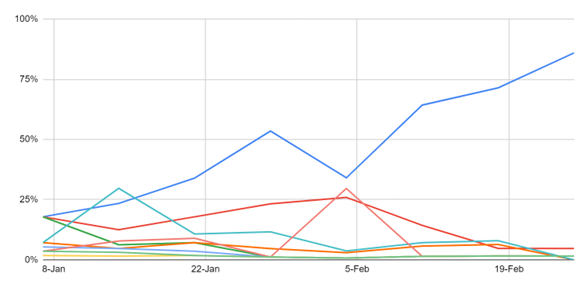
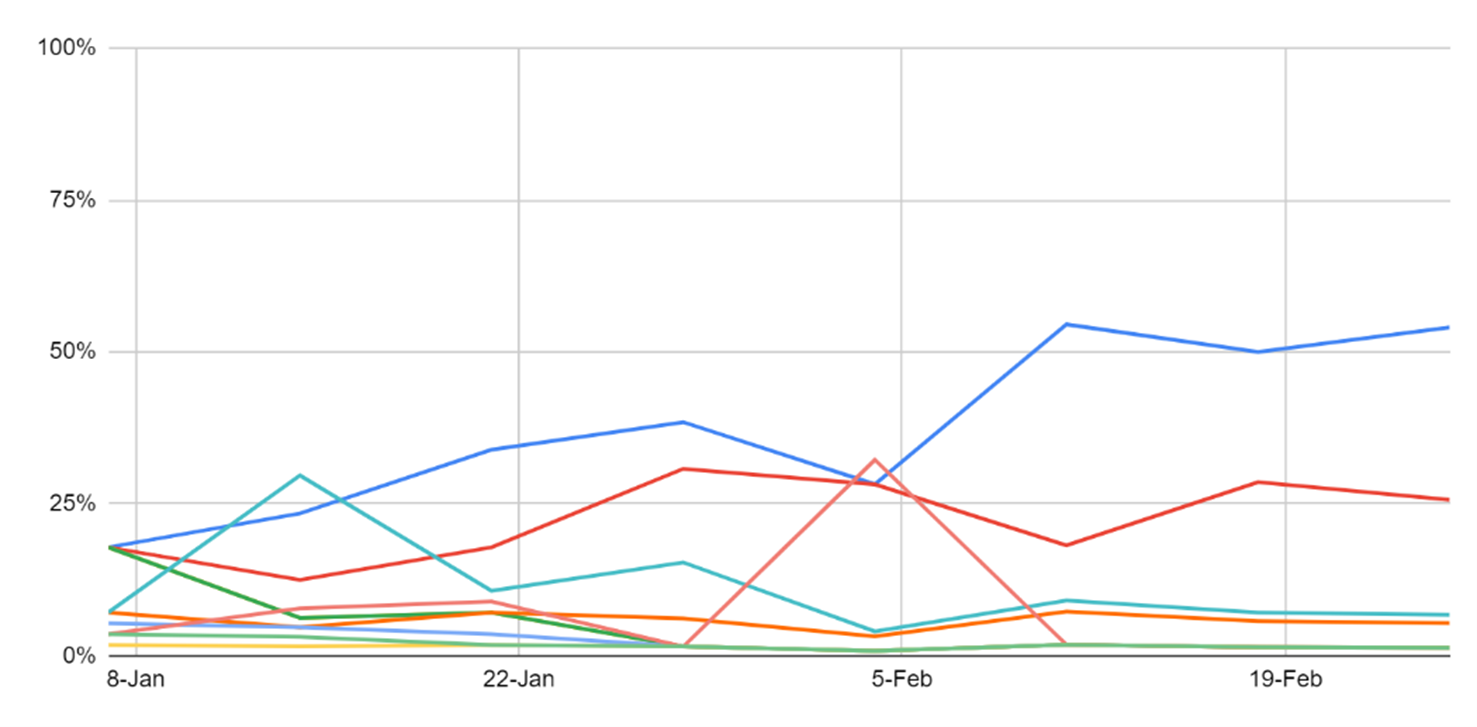
<p>While I was doing tests, I tracked the probability I assigned to different options, as well as noting what information caused big swings in my probabilities. This let me notice and track changes to my expectations around which option was best.</p>

<p>I updated my spreadsheet weekly for the first couple months while I was exploring and learning about options (roughly corresponding to the period when I was brainstorming, writing project briefs, and doing tests taking &lt;1 week). Once I started longer tests, I switched to monthly, until I committed to Tarbell.</p>

<h2 id="example-5">Example</h2>

<p><img src="/assets/images/Picture1-13cec0.png" alt="" /></p>

<h2 id="tips-for-you-to-apply-6">Tips for you to apply</h2>

<p>Here’s an excerpt from my post on <a href="/blog/2024/4/7/how-much-career-exploration-is-enough">How Much Career Exploration Is Enough?</a></p>

<p>Track when you stop changing your mind about which option is best. Even with an important decision, you only want to spend more time exploring as long as that exploration is changing your mind about which job is most valuable.</p>

<p>To measure how much your mind is changing, you can set up a spreadsheet with probabilities for how likely it is you’ll do each of the options you’re considering.</p>

<p>Try to write down numbers that feel reasonable and add up to 100%. (To avoid having to manually make the numbers equal 100, you can add numbers on a 1-10 scale for how likely each option feels, and then divide each number by the total.)</p>

<p><a href="https://docs.google.com/spreadsheets/d/1SzvlfUHhtr_w-xmTVZKXyeYndtHKnOjnIH4ni2hrLLU/edit?usp=sharing">Template sheet with example</a></p>

<p>Each week while you’re exploring, put in your new numbers. As you get more information and your decision is more solid, the numbers will slowly stop changing (and one option will probably be increasingly closer to 100%).</p>

<p>When your probabilities are changing wildly, you’re still gaining more information. Once they taper off, you’ve neared the end of productive returns to your current exploration.</p>

<h1 id="reevaluation-points">Reevaluation Points</h1>

<p>Both tests for productivity blogging and AI journalism were both promising. I would be happy continuing productivity blogging, if AI journalism turns out to be a poor fit.</p>

<p>In the end though, AI just seems too important to ignore. So I committed to the Tarbell Fellowship. I spent the spring doing an AI journalism spinning up program, and this month I’m starting the nine-month main portion of the fellowship.</p>

<p>After those nine months, I’ll reevaluate. I’ve got a set of key questions I’m testing, including about <a href="/blog/2020/11/16/theory-of-change-as-a-hypothesis">theory of change</a> and <a href="https://80000hours.org/career-guide/personal-fit/">personal fit</a>. I also expect I’ll learn tons of things that I don’t know enough now to ask about.</p>

<p>I already learned so much about journalism – including that several of my assumptions during my early tests were wrong. For example, I focused so much on writing speed, whereas now I would have focused on reporting.</p>

<p>Despite all the flaws in my understanding at the time, I still think the tests were a reasonable approach to making better informed decisions. The iterative information gathering allowed me to make measured investments until I was ready to make a big commitment.</p>

<p>Now I’ll dive into journalism. At the end of the fellowship, I’ll decide what comes next. Right now, I hope to continue. I’m confident this is worth trying, even though I’m not confident what the end result will be. But I’m doing my best to set myself up for success along the way, including telling all of you that I’m doing this (if you have stories that should be told, please let <a href="mailto:lynettebye@gmail.com">me</a> know!) You might already have noticed the changes to my website.</p>

<p>In the meantime, I’ll be writing less on this blog. Come check out my <a href="https://lynettebye.substack.com/">substack</a> for AI writing instead!</p>

<h2 id="tips">Tips</h2>

<p>After you commit to one career path, reevaluate periodically to check your work is a good fit and as impactful as you hoped. Your work may have natural evaluation points (such as a nine-month fellowship). Otherwise, about once a year often works well. At each reevaluation point, ask yourself if you learned anything that might make you want to change plans? Are there new options that might be much better than what you’re currently doing? If so, do another deep dive. If not, keep doing the top option.</p>

<h1 id="credits">Credits</h1>

<p>Thanks to everyone who gave me advice and feedback on this long journey. Special thanks to Kit Harris, Anna Gordon, Garrison Lovely, Miranda Dixon-Luinenburg, Joel Becker, Cillian Crosson, Shakeel Hashim, and Rohin Shah.</p>]]></content><author><name></name></author><summary type="html"><![CDATA[I did a major career review during 2023. I’m sharing it now because:]]></summary></entry><entry><title type="html">How to make career decisions and have impact</title><link href="https://lynettebye.com/blog/2024/5/2/how-to-make-hard-decisions-and-have-impact" rel="alternate" type="text/html" title="How to make career decisions and have impact" /><published>2024-05-02T12:16:16+00:00</published><updated>2024-05-02T12:16:16+00:00</updated><id>https://lynettebye.com/blog/2024/5/2/how-to-make-hard-decisions-and-have-impact</id><content type="html" xml:base="https://lynettebye.com/blog/2024/5/2/how-to-make-hard-decisions-and-have-impact"><![CDATA[<p><img src="/assets/images/0dayssincelastexistentialcrisisovercareerchoice-08884d.jpg" alt="" /></p>

<p>Some career decisions are easy. There’s a clear best option.</p>

<p>Many are <em>not</em> easy. Where are you a good fit? What would you be best at? What work is most important?</p>

<p>These questions can feel baffling. How do you even start getting the information to make these decisions well?</p>

<p>Do you wish you could just look at how successful people made their decisions? What made them confident in their plans?</p>

<p>Well, here you can. Here are 10+ real stories of career decisions. Each story is a real account from a real person. You can see what works – and what doesn’t.</p>

<p>Even better, these stories illustrate three big tools for making important, complex decisions. You’ll learn high-level strategies for efficiently gathering vital information, so that you’ll be able to confidently make decisions.</p>

<p>In case you’re wondering how I came up with these, I brainstormed 25+ examples, clustered them, got feedback from a few people, and then selected the best examples for the most important clusters.</p>

<p>So, why should you read 6k words of stories? Why don’t I just give you the tools in a bullet list?</p>

<p>Because abstract concepts alone aren’t enough. There are already lots of resources for generic advice. But hard career decisions are nuanced and complex.</p>

<p>When you only have the abstract advice, it can be hard to <a href="https://commoncog.com/how-note-taking-can-help-you-become-an-expert/">apply</a> to all of the situations where you need it. Personal fit tests for someone exploring bio careers are going to look very different than my tests for journalism. It’s also easy to <em>think</em> you understand the advice, when actually you’re <a href="https://www.lesswrong.com/posts/k9dsbn8LZ6tTesDS3/sazen">missing</a> important details.</p>

<p>For example, 80,000 Hours has some great <a href="https://80000hours.org/career-planning/process/feedback-and-investigation/">advice</a> on investigating uncertainties. However, beyond talking to people and reading their posts, their advice for testing is “Look for ways to test your uncertainties.” They give one example of what this might look like, but one example isn’t enough. That sentence deserves its own entire blog post!</p>

<p>This is that blog post. The stories teach you the details to flexibly apply these tools. They’re meant to convey the tools in depth so you can apply them yourself in a variety of situations. Because, of course, career decisions don’t stop once you have a job. Doing research, starting a charity, or planning your team’s next project all benefit from the same tools.</p>

<p>And, hey, if you’re not sold on reading the case studies, you can always jump to the conclusion to read the super high level summary of the whole process.</p>

<p>But I hope you’ll read the whole thing. I think most of the value comes from seeing the strategies in action.</p>

<p><img src="/assets/images/Iamabsolutelyparalyzedbydecisionmaking2Canditisdestroyingmyimpact21-acce90.jpg" alt="" /></p>

<h1 id="data-rich-experiments">Data rich experiments</h1>

<p>Identify your key uncertainties, then find the richest <em>real-world</em> data possible to help you reduce them.</p>

<p>For data rich experiments, you want to get as close to the real-world setting as possible. If you’re testing job fit, you want to try doing work that’s as close as possible to the real job.</p>

<p>You’ll need to start by identifying your key uncertainties, then find ways to quickly get data to reduce those uncertainties.</p>

<p>Data rich experiments usually structure effort in the order that decreases your uncertainty most quickly (e.g. start with most likely to fail and work towards least likely to fail). You want to tackle your biggest uncertainties quickly with tests that yield a lot of info.</p>

<p>Rich data is usually external. There’s a detailed, nuanced world out there, and you need to have lots of data points from bumping into it. Get your <a href="https://mindingourway.com/dive-in-2/">hands dirty</a>! Go talk to people, try things, learn how the world works.</p>

<p>For my career exploration, “finding the richest data” meant looking for experiments where I expected to be surprised. I couldn’t easily predict what the outcome would be. For example, I didn’t know what I would discover by submitting pitches. I expected more information on whether I liked the activity, but it was novel enough that I expected to learn surprising things. Just trying something new is often a rich source of data since my models were poor before. (If I’m repeating things I’ve done many times, I don’t expect to learn much.)</p>

<p>I did some tests as “sanity checks” to confirm I didn’t have gaping misunderstandings. But in general, if I expect a certain outcome, I don’t learn much by testing it. So I look for those tests where I can’t confidently predict the outcome.</p>

<p>Better yet, I look for tests that will give me detailed, nuanced feedback. If I’m just testing whether I can draft a post in a day, the answer is yes or no. A richer data set is investigating what factors predict how fast I draft a post. An even richer data set (for career exploration) would have been testing how quickly I can draft a journalism-style piece and comparing it against a published piece. Here the data is getting richer the more detail I’m extracting and the closer the test is to the real-world scenario I’m testing.</p>

<p>Question to ask yourself: What are my key uncertainties right now? What are the most detailed, closest-to-real scenario tests I could run to reduce those uncertainties?</p>

<p><em>Extra:</em></p>

<ol>
  <li>This method clicked for me when I sought out tests where the result was high variance - they could go either way, and I couldn’t predict in advance what I would learn. I suspect that’s often a good litmus test for telling whether a test might yield rich data.</li>
</ol>

<p>Asking other people for advice or reading works about the topic are a good starting point for finding data rich tests. My career tests were based on advice from people in the field. My user testing interviews were based on the process in the book Sprint.</p>

<ol>
  <li>Do what’s uncomfortable.</li>
</ol>

<p>By definition, testing things means you’re not sure what the outcome will be. That’s often uncomfortable. For example, you can spend hours debating the relative merits of two jobs, but if your biggest uncertainty is whether you can get job offers, you should probably just apply and then compare the job offers. You’ll save yourself a lot of time that wasn’t ultimately moving you forward.</p>

<p>In my therapy platform project, I was so tempted to just start designing evaluations. I could have worked quite happily to create a project I loved – without realizing it had serious flaws that would later make it fail. Instead, I got feedback early, far before I felt ready to do so. Because I got that feedback early, I could pivot without wasting too much effort on the discarded idea.</p>

<p>Don’t wait until you feel totally ready to share your idea. Test your assumptions, get feedback, and crash your idea against reality early and often.</p>

<p>Question to ask yourself: Is there a test that would give me valuable information that I’m avoiding because it feels ughy or scary or uncomfortable?</p>

<h2 id="ben-kuhns-hiring-process">Ben Kuhn’s hiring process</h2>

<p><a href="https://www.benkuhn.net/behavioral/#:~:text=My%20formula%20for%20kicking%20off,and%20how%20you%20addressed%20it.">Ben Kuhn</a> uses a careful approach to planning behavioral interviews to extract enough data that he can make informed hiring decisions.</p>

<p>“One of the worst mistakes you can make in a behavioral interview is to wing it: to ask whatever follow-up questions pop into your head, and then at the end try to answer the question, “did I like this person?” If you do that, you’re much more likely to be a “weak yes” or “weak no” on every candidate, and to miss asking the follow-up questions that could have given you stronger signal.”</p>

<p>He plans detailed questions in order to get rich data that is close to how they would likely perform if he hired them. For example, he emphasizes digging into the details. “Almost everyone will answer the initial behavioral interview prompt with something that sounds vaguely like it makes sense, even if they don’t actually usually behave in the ways you’re looking for. To figure out whether they’re real or BSing you, the best way is to get them to tell you a lot of details about the situation—the more you get them to tell you, the harder it will be to BS all the details.”</p>

<h2 id="giving-what-we-cans-failed-forum">Giving What We Can’s failed forum</h2>

<p><strong>Michelle:</strong> When we were building a forum for Giving What We Can, we were trying to build a forum that was exactly of the kind that we wanted, and it ended up really blowing out as a project.</p>

<p>I hadn’t managed a tech project before. We were still mostly volunteers, and it ended up taking many months and just totally wasn’t worth it. It didn’t end up being used very much at all.</p>

<p>I think that’s a case where I hadn’t properly zoomed out and been like, “Okay, how important actually is this, and at what point should we pivot away from working on this, even if we put quite a bit of time into it?”</p>

<p><strong>Lynette:</strong> Sounds good. Knowing what you do now about zooming out, what would you have done differently early on? Concretely, what would that have looked like?</p>

<p><strong>Michelle:</strong> I think it probably would have looked like doing more of a minimum viable product. I think we considered this at the time and our worry was that a forum only works if you get enough people on it. If you do something that’s fine but not great, then you get a few people, and you just don’t get enough. It’s bound to fail.</p>

<p>I think, for example, the Giving What We Can Community Facebook group, which I think is what we ended up going with, has actually done pretty well and got fairly good engagement on it. I think I might have just ended up sticking with that.</p>

<p>I might have tried something like a Google Group with some different threads and then sent that around and been like, “Do people want something like this?” I guess something that was quick to build and could immediately see whether people were using it.</p>

<h2 id="testing-key-uncertainties-in-my-career-exploration">Testing key uncertainties in my career exploration</h2>

<p>Around the beginning of 2023, I started a career review to decide if I wanted to do something besides coaching.</p>

<p>I liked writing and thought journalism seemed potentially impactful. However, I knew basically nothing about what journalism actually involved day-to-day and I had only a vague theory of change. So my key uncertainties were: What even is journalism? Would journalism be high impact/was there a good <a href="/blog/2020/11/16/theory-of-change-as-a-hypothesis">theory of change</a>? Would I be a good fit for journalism?</p>

<p><em>Cheapest experiments:</em></p>

<p>So I started by doing the quickest, cheapest test I could possibly do: I read 80,000 Hours’ profile on journalism and a few other blog posts about journalism jobs. This was enough to convince me that journalism had a reasonable chance of being impactful.</p>

<p>Meanwhile, EA Global rolled around and I did the second cheapest quick test I could do: I talked to people. I looked up everyone on Swapcard (the profile app EAG uses) who worked in journalism or writing jobs and asked to chat. Here my key uncertainties were: What was the day-to-day life of a journalist like? Would I enjoy it?</p>

<p>I quickly learned about day-to-day life. For example, the differences between staff and freelance journalism jobs, or how writing is only one part of journalism – the ability to interview people and get stories is also important. I also received advice to test personal fit by sending out freelance pitches.</p>

<p><em>Deeper experiment 1:</em></p>

<p>On the personal fit side, one key skill the 80,000 Hours’ profile emphasized was the ability to write quickly. So a new, narrowed key uncertainty was: Can I write fast enough to be a journalist?</p>

<p>So I tried a one-week sprint to draft a blog post each day (I couldn’t), and then a few rounds of <a href="/blog/2023/7/27/diy-deliberate-practice">deliberate</a> practice exercises to improve my writing speed. I learned a bunch about scoping writing projects. (Such as: apparently, I draft short posts faster than I do six-thousand-word research posts. Shocking, I know.)</p>

<p>It was, however, an inconclusive test for journalism fit. I think the differences between blogging and journalism meant I didn’t learn much about personal fit for journalism. In hindsight, if I was optimizing for “going where the data is richest”, I would have planned a test more directly relevant to journalism. For example, picking the headline of a shorter Vox article, trying to draft a post on that topic in a day, and then comparing with the original article.</p>

<p><em>Deeper experiment 2:</em></p>

<p>At this point, I had a better picture of what journalism looked like. My questions had sharpened from “What even is this job?” to “Will I enjoy writing pitches? Will I get positive feedback? Will raising awareness of AI risks still seem impactful after I learn more?”</p>

<p>So I proceeded with a more expensive test: I read up on how to submit freelance pitches and sent some out. In other words, I just tried doing journalism directly. The people I’d spoken with had suggested some resources on submitting pitches, so I read those, brainstormed topics, and drafted up a few pitches. One incredibly kind journalist gave me feedback on them, and I sent the pitches off to the black void of news outlets. Unsurprisingly, I heard nothing back afterwards. Since the response rate for established freelance writers is only around 20%, dead silence wasn’t much feedback.</p>

<p>Instead, I learned that I enjoyed the process and got some good feedback. I also learned that all of my pitch ideas had been written before. Someone, somewhere had a take on my idea already published. The abundance of AI writing undermined my “just raise awareness” theory of change.</p>

<p><em>Deeper experiment 3:</em></p>

<p>Since I was now optimistic I would enjoy some jobs in journalism, my new key uncertainties were: Could I come up with a better, more nuanced theory of change? Could I get pieces published or get a job in journalism?</p>

<p>I applied to the Tarbell Fellowship. This included work tests (i.e. extra personal fit tests), an external evaluation, and a good talk about theories of change, which left me with a few promising routes to impact. (Yes, applying to roles is scary and time consuming! It’s also often a very efficient way to test whether a career path is promising.)</p>

<p><em>Future tests:</em></p>

<p>Now my key uncertainties are about how I’ll do on the job: Will I find it stressful? Will I be able to write and publish pieces I’m excited about? Will I still have a plausible theory of change after deepening my models of AI journalism?</p>

<p>It still feels like I’m plunging into things I’m not fully prepared for. I could spend years practicing writing and avoiding doing anything so scary as scaling down coaching to work at a journalism org – at the cost of dramatically slowing down the rate at which I learn.</p>

<h2 id="learning-my-idea-sucked">Learning my idea sucked</h2>

<p>At EAG 2022, I stumbled onto some conversations about the need for vetted EA therapists and coaches. Could we thoroughly evaluate a few providers? We could provide detailed insight into their methods and results, so that EAs could find providers with solid evidence of impact. Would it be possible to identify coaches who get 10x the results for their clients?</p>

<p>I was really excited about this idea.</p>

<p>As I’m also a fan of lean methods, I designed some user testing interviews for my idea. If I was to build something like a mini-GiveWell-style evaluator for therapists and coaches, it would probably take months or years of effort. Before I invested that, I wanted to refine my idea. The goal wasn’t to build the vetting process more quickly at first, the goal was to figure out what vetting process to build.</p>

<p>So I followed the process outlined in <a href="https://www.goodreads.com/book/show/25814544-sprint">Sprint</a>. I built mock prototypes with fake data showing the kinds of evaluation info I hoped to include, plus Calendly links and availability data. I scheduled user testing interviews and watched how they interacted with the prototypes. I also hopped on calls with a few providers to discuss the possibility of including them in the vetting process.</p>

<p>Basically, I jumped into the data as richly as possible. And it told me that my precious, exciting idea…sucked.</p>

<p>First, the providers had limited space for new clients. One had a ten-month waiting list to work with her. Even if each provider could take on 20 or 30 clients, they already had full schedules and would only gradually have space for new clients. My plan for “a few, highly vetted providers” would only benefit a small number of clients.</p>

<p>Second, the potential users didn’t place much weight on the evaluations. They cared more about whether a provider was covered by their insurance or whether they specialized in a particular issue.</p>

<p>Both of these indicated that a larger database of providers would be better, even if that meant forgoing the deep vetting process I’d wanted.</p>

<p>So I let go of my original plan. That sucked a bit. I’d been excited about it.</p>

<p>One piece of advice I got to help this kind of thing was “It’s much easier to go towards rich data if you’re curious or open. If you’re finding internal resistance, then try to ramp up curiosity.” Here I felt curious about what would help EAs most, so I got excited about the new idea pretty quickly.</p>

<p>I worked with the EA Mental Health Navigator to revamp and expand their provider database. This was a much smaller and quicker project that, I think, turned out strictly better than my original idea.</p>

<h2 id="jacob-steinhardts-approach-to-failing-fast-in-research">Jacob Steinhardt’s approach to failing fast in research</h2>

<p>For those of you more mathematically minded, Jacob Steinhardt has a beautiful <a href="https://cs.stanford.edu/~jsteinhardt/ResearchasaStochasticDecisionProcess.html">post</a> about how to reduce uncertainty most efficiently. Specifically, he recommends that you structure your research in the order that decreases your uncertainty most quickly. E.g. start with most likely to fail and work towards least likely to fail. (Additionally, multiple clients have told me it was helpful for speeding up their research as well.)</p>

<p>He claims this method <strong>quadrupled</strong> his research output.</p>

<p>I’ve included a few excerpts from it here:</p>

<blockquote>
  <p>Suppose you are embarking on a project with several parts, all of which must succeed for the project to succeed. For instance, a proof strategy might rely on proving several intermediate results, or an applied project might require achieving high enough speed and accuracy on several components. What is a good strategy for approaching such a project? For me, the most intuitively appealing strategy is something like the following:</p>

  <p><strong>(Naive Strategy)</strong><br />
Complete the components in increasing order of difficulty, from easiest to hardest.</p>

  <p>This is psychologically tempting: you do what you know how to do first, which can provide a good warm-up to the harder parts of the project. This used to be my default strategy, but often the following happened: I would do all the easy parts, then get to the hard part and encounter a fundamental obstacle that required scrapping the entire plan and coming up with a new one. For instance, I might spend a while wrestling with a certain algorithm to make sure it had the statistical consistency properties I wanted, but then realize that the algorithm was not flexible enough to handle realistic use cases.</p>

  <p>The work on the easy parts was mostly wasted–it wasn’t that I could replace the hard part with a different hard part; rather, I needed to re-think the entire structure, which included throwing away the “progress” from solving the easy parts.</p>

  <p>Rather, we should prioritize tasks that <em>are more likely to fail</em>(so that we remove the risk of them failing) but also tasks that <em>take less time</em> (so that we’ve wasted less time if one of the tasks does fail, and also so that we get information about tasks more quickly).</p>

  <p><strong>A Better Strategy: Sorting by Information Rate</strong></p>

  <p>We can incorporate both of the above desiderata by sorting the tasks based on which are <em>most informative per unit time</em>.</p>

  <p><strong>(Better Strategy)</strong><br />
Do the components in order from most informative per unit time to least informative per unit time.</p>

  <p>Example 1: All of the steps of a project have roughly equal chance of success (80%, say) but take varying amounts of time to complete.</p>

  <p>In this example we would want to do the quickest task first and slowest last, since the later a task occurs, the more likely we will get to skip doing it. Sorting “easiest to hardest” is therefore correct here, but it is rare that all steps have equal success probability.</p>

  <p>Example 2: An easy task has a 90% success probability and takes 30 minutes, and a hard task has a 40% success probability and takes 4 hours.</p>

  <p>Here we should do the easy task first: if it fails we save 240 minutes, so 0.1 * 240 = 24 minutes in expectation; conversely if the hard task is done first and fails, we save 30 minutes, for 0.6 * 30 = 18 minutes in expectation. But if the hard task takes 2 hours or the easy task has a 95% chance of success, we should do the hard task first.</p>

  <p>Thus, in this method we formalized “most informative per unit time” by looking at how much time we save (in expectation) by not having to do the tasks that occur after the first failure.</p>
</blockquote>

<h1 id="iterated-depth">Iterated depth</h1>

<p>The idea of iterated depth is that you start with a wide range of options, shallowly explore them, move the most promising onto the next round of exploration, and repeat with increasingly in-depth explorations.</p>

<ol>
  <li>Start with small tests and build up.</li>
</ol>

<p>Start with the cheapest, easiest tests that are teaching you new information. For Kit, this meant asking a friend about their job, reading a blog post about what it’s like to work in that industry, or looking at available job postings. For Allan or CE, it means doing a 30-minute write up before committing to spending hours or months on a project.</p>

<p>Go deeper with more extensive and expensive tests as you need to but ONLY as you need to. Don’t do a month-long project before you’ve spent a weekend trying it out. Don’t do a weekend-long project until you’ve spent an hour reading about the job.</p>

<p>Question to answer: What are the smallest, cheapest tests that would have a decent chance of changing my mind about which options are the best fit for me?</p>

<ol>
  <li>Start with a big top of the funnel and gradually narrow.</li>
</ol>

<p>Don’t make decisions based on only one data point. If the first option you tried goes okay, still try more options. You need the ability to compare multiple options to see when something is going unusually well vs just okay vs unusually horribly.</p>

<p>Serendipity and chance play a big role in career exploration, but you want at least a few data points so that you’re optimizing for the best out of five or ten options, rather than the best out of one or two.</p>

<p>Start with more career paths or specific jobs or project ideas than you can follow, and do a tiny bit of exploration in several. Then go deeper on a select few, narrowing the number you’re trying with each step. By the time you’re accepting a job or committing to a project, you want to have explored several other paths.</p>

<p>Question to answer: Am I considering at least three options (ideally ten plus options) for early stages of the funnel?</p>

<p>Extra:</p>

<p>You likely won’t feel convinced you know enough to cut off all the other paths. You’re trying to gain more robust clarity – where it’s harder to get new information that would change your choice. (See <a href="/blog/2024/4/7/how-much-career-exploration-is-enough">How much career exploration is enough?</a>)</p>

<p>You might end up going back up a step if a deep dive doesn’t pan out, say if an internship doesn’t go as well as you would like. That’s a good time to reconsider other paths that seemed promising.</p>

<h2 id="kits-career-exploration">Kit’s career exploration</h2>

<p>When Kit Harris wanted to reassess his career, he started from scratch. (You can read his longer account of the process <a href="https://docs.google.com/document/d/1QxRYEnINNUBr2anSdfc5dVdaTnV5muiWzpvdT4-scDQ/edit">here</a>.)</p>

<p>He identified 50 potentially high-impact roles spanning operations, generalist research, technical and strategic AI work, grantmaking, community building, earning to give, and cause prioritization research.</p>

<p>Then he roughly ranked them by promisingness and explored the top 10 ideas more deeply. “At first, the idea of choosing 1 next step from 50 ideas was quite overwhelming. Explicitly arranging the ideas made exploration much more approachable.”</p>

<p>He started with brief explorations, such as:</p>

<ul>
  <li>Talking to someone working in a similar role</li>
  <li>Talking briefly with potential collaborators</li>
  <li>Beginning but not finishing an application, learning from the process what might make me a good fit</li>
</ul>

<p>Then he advanced to deeper investigations of the most promising ideas, such as:</p>

<ul>
  <li>Selecting small projects which seemed representative of the work and trying them</li>
  <li>Applying for a position which had work tests in the application process</li>
  <li>Contracting for a relevant organization</li>
  <li>Interviewing relevant people and presenting an organization with a project plan</li>
</ul>

<p>At the end of the process, he spent time contracting for Effective Giving UK (now Longview Philanthropy), and ultimately accepted a full-time job there. Kit wrote that he felt “quite confident” in his decision.</p>

<h2 id="founding-charities">Founding Charities</h2>

<p>To choose which charities to found, Charity Entrepreneurship uses an iterative depth approach.</p>

<p>“With our 2020 charity research, that meant doing a quick 30-minute prioritization of hundreds of ideas, then a longer two-hour prioritization of dozens of ideas, and, finally, an 80-hour prioritization of the top five to ten. Each level of depth examines fewer ideas than the previous round, but invests considerably more time into each one.” <em>From</em> <a href="https://www.goodreads.com/en/book/show/60132743"><em>How to launch a high-impact nonprofit</em></a></p>

<p><a href="https://www.givewell.org/research/research-on-programs">GiveWell</a> and <a href="https://www.openphilanthropy.org/cause-selection/#content-2-1">Open Philanthropy</a> use a similar process for selecting priority charities.</p>

<p>You can read a longer <a href="https://www.charityentrepreneurship.com/post/using-a-spreadsheet-to-make-good-decisions-five-examples">description</a> here of Charity Entrepreneurship’s process from an early round.</p>

<h2 id="allan-dafoes-shallow-research-tests">Allan Dafoe’s shallow research tests</h2>

<p><em>Jade</em> <a href="/blog/2022/5/5/jade-leung"><em>Leung’s</em></a> <em>account of how her former professor, Allan Dafoe, selected research projects:</em></p>

<p>“He always has a running list of research ideas, way more than he could ever get done. He explores more ideas than he would actually be able to follow through with.</p>

<p>By this process of light experimentation, he delves into the idea and tries to understand it a little bit better. Maybe writing up a couple of pages on it and getting into the mode of actually investigating it.</p>

<p>I think that gave him a bunch more data about whether this was a project that actually had the legs that he thought it could have, whether it felt pleasant and fun to work on, whether it felt like it was exploring a bunch of other ideas, or whether it felt a bit flat.”</p>

<p>An easy way to try this is to keep your attention open for promising ideas and have a place you can jot these down with minimal friction.</p>

<h1 id="closing-the-loop">Closing the loop</h1>

<p>Closing the loop is about having systems to constantly experiment, learn from the tests, and plan new experiments based on your updated hypothesis. This process of constantly iterating enables the iterated depth and data rich methods above.</p>

<p>There’s a leap of faith to committing to a career path. You have to make commitments before you have deep models that can really inform you, so you’re always making the choice to start something based on less information than you will have later.</p>

<p>But you want to reevaluate that path once you get more information. You want to check whether you’re still on the right path as your model becomes more granular. Related: <a href="/blog/2020/11/16/theory-of-change-as-a-hypothesis">Theory of Change as a Hypothesis</a></p>

<p>To do this, you want to be able to run longer experiments, and know you’re going to circle around and update your hypothesis based on the data you gathered.</p>

<p>For me, reevaluation points are a good way to balance bigger experiments with frequent check-ins. Quarterly reevaluation points especially help when I’m feeling down or pessimistic about my work. When this happens, my instinct is to immediately reevaluate my entire career path. Having a record of the reasons behind my plans is <em>immensely</em> helpful when I feel like my blog draft is terrible and should never see the light of day and maybe I should immediately quit blogging forever.</p>

<p><em>Extra:</em></p>

<p>Keep your feedback loops small.</p>

<p>When running experiments, you don’t want the end of a year “exploring” research to be the first time you analyze how it’s going. Even for longer experiments, you want smaller loops of collecting more granular data.</p>

<p>Build up to big conclusions with regular bits of data. Keep close to the data, so that you’re constantly making little bits of contact with it.</p>

<h2 id="failing-to-learn-from-exploration">Failing to learn from exploration</h2>

<p>I spent the year after college doing psych research as a test for whether I wanted to do grad school. At the end, disillusioned with psych research, I knew the answer was no.</p>

<p>I just had no idea what I <em>did</em> want to do.</p>

<p>I spent a year “testing” whether I wanted to do research, but at no point was I actually collecting data or even thinking about what I wanted to learn from that test.</p>

<p>I wasn’t repeatedly circling around to plan what data to collect, collecting it, updating beliefs, and then planning new tests. In other words, I wasn’t closing the loop.</p>

<p>I could have broken my key uncertainties (e.g. will I be a good fit for a PhD?) into small components and looked for data (or ways to get data) on them. I could have kept a log of which elements of my job I enjoyed and which I slogged through. I could have noted where I got praised and where I received silence or negative feedback. I could have done some tests of other options in my free time. I could have asked other people about their labs, to check whether my experience was typical for the field.</p>

<p><strong>Ideally, I would have had a system where I thought weekly about what I learned and kept a log of updates. I could have planned questions in advance to pay attention to during the week.</strong></p>

<p>Instead, I just did my work and tried to reflect at the end. Then, I could generate career ideas but I didn’t have good data points from which to evaluate my ideas. I didn’t have a good sense of my strengths or weaknesses. I had to work to even figure out what I liked.</p>

<p>I think this was really a wasted opportunity.</p>

<h2 id="developing-a-weekly-system">Developing a weekly system</h2>

<p>I wanted a good way to regularly circle back to close the loop on little experiments. So I came up with this process of hypothesis driven loops.</p>

<p>The basic idea was: while planning my week, I would also plan what data I was collecting to help with career exploration. I wrote down my questions, how I was collecting data, and what I currently predicted I would find (plus how confident I was).</p>

<p>All of this made it easier to notice when I was surprised. I was collecting data from recent experiences when it was fresh in my mind. Because I was writing in advance what I guessed I’d find, it was easy to notice when I actually found something quite different.</p>

<p>It allowed me to plan what I wanted to learn from my goals each week, have that in the back of my mind, and reliably circle around the next week to write down any info. This left a written trail documenting the  evolution of my plans.</p>

<p>Some examples:</p>

<p>When I was trying to assess whether I should continue working on the ML engineer accelerator program ARENA after the first iteration. One of my key uncertainties was whether the other leaders running ARENA thought it was worth continuing.</p>

<p>Hypothesis: When I talk with Matt and Callum about ARENA, it will pass this first test for scalability (65%).</p>

<p>Result: It passed the scalability test, but Callum is going to try exploring himself. I think he’s a much better fit than I am, so I’m happy to let him take it on. I’ll reevaluate later if he doesn’t continue or I get new information.</p>

<p>When I was drafting the <a href="/blog/2023/4/20/inside-the-minds-of-adhd">ADHD</a> post. I wanted to test how long it took me to conduct interviews, since I hadn’t done that for a post previously.</p>

<p>Hypothesis: Reach out to people/schedule interviews/have interviews/draft post in 1 week: ambitious goal, but seems good to try for my goal of writing faster. 30% I can have a draft by the end of the week. 70% I can do at least 2 interviews.</p>

<p>Result: I didn’t get around to drafting, but I did six interviews.</p>

<h2 id="cedric-chins-hypothesis-system">Cedric Chin’s hypothesis system</h2>

<p><a href="https://commoncog.com/no-learning-dont-close-loops/">You Aren’t Learning If You Don’t Close the Loops</a> by Cedric Chin, author of CommonCog, emphasizes the importance of studying the results of experiments to actually learn from your trials. His system is a good example of systems for exploring bigger key uncertainties over time. Excerpt:</p>

<p>“Here at Commoncog we spent four months working on our Burnout Guide, summarizing the bulk of burnout research in one easy-to-read piece. The original intention for this guide was to see if we could use a set of commonly known SEO techniques to grow the site’s rankings. But the guide went viral on launch. I was so distracted by the distribution, the positive feedback and the attention that the guide was getting that I nearly forgot about the original hypotheses that we had. It was only when I consulted the original 6-pager I wrote at the outset that I realised we needed to test certain things; the virality was nice but not the main purpose of this particular execution loop.</p>

<p>(This is, by the way, an explicit recommendation to write out your hypotheses before you execute. It doesn’t matter if you jot it down in a 6-pager format or a Google Doc or whatever; the point is that you’re likely to forget your original goals by the end of a loop if you don’t put things down on a page.)”</p>

<h1 id="conclusion">Conclusion</h1>

<p>The next time you need to make a complex, important decision where it’s worth it to put in 100 hours, you should upfront plan a process that looks something like this.</p>

<ol>
  <li>Start with brainstorming a broad top of the funnel.</li>
  <li>Identify your key uncertainties.</li>
  <li>Get data points as close to the real-world setting as possible so you can compare.</li>
  <li>Iteratively narrow and deepen the best ones.</li>
  <li>Structure your effort in the order that decreases your uncertainty most quickly. E.g. start with most likely to fail and work towards least likely to fail.</li>
  <li>Have systems that let you regularly circle back to check what you’re learning and update your hypotheses.</li>
</ol>

<p>Hopefully the case studies helped you think about how to do that. If you want more help, please reach out! I’d love to help design great career tests.</p>

<h1 id="related-resources">Related resources:</h1>

<p>My blog post <a href="/blog/2020/11/16/theory-of-change-as-a-hypothesis">Theory Of Change As A Hypothesis: Choosing A High-Impact Path When You’re Uncertain</a> was an earlier attempt to apply the importance of regular iteration for reducing uncertainty in career choice.</p>

<p>Logan Strohl’s <a href="https://www.lesswrong.com/s/evLkoqsbi79AnM5sz">naturalism</a> posts are one way to think more about getting in close contact with the data. My guess is that you’ll know pretty quickly whether you click with his style, so feel free to check it out and move on if this one isn’t for you.</p>

<p>Reading about LEAN methods, particularly The Lean Startup and similar takes on lean as a “method for iterating quickly to reduce uncertainty” is another helpful take.</p>]]></content><author><name></name></author><summary type="html"><![CDATA[]]></summary></entry><entry><title type="html">How much career exploration is enough?</title><link href="https://lynettebye.com/blog/2024/4/7/how-much-career-exploration-is-enough" rel="alternate" type="text/html" title="How much career exploration is enough?" /><published>2024-04-11T09:08:09+00:00</published><updated>2024-04-11T09:08:09+00:00</updated><id>https://lynettebye.com/blog/2024/4/7/how-much-career-exploration-is-enough</id><content type="html" xml:base="https://lynettebye.com/blog/2024/4/7/how-much-career-exploration-is-enough"><![CDATA[<p>When do you stop exploring career options? How do you know when you should commit to one job or project?</p>

<p>Ideally, you want to trade off the chance new information changes your mind against the effort it takes to get new information. The longer you spend exploring, the less time you have to actually get stuff done. (More or less – it’s not a strict trade off since some exploration is also directly useful.)</p>

<p>Except, it’s really hard to do that calculation robustly.</p>

<p>One alternative is to explore, and track when you stop changing your mind about which option is best. Even with an important decision, you only want to spend more time exploring as long as that exploration is changing your mind about which job is most valuable.</p>

<p>To measure how much your mind is changing, you can set up a spreadsheet with probabilities for how likely it is you’ll do each of the options you’re considering.</p>

<p>Try to write down numbers that feel reasonable and add up to 100%. (To avoid having to manually make the numbers equal 100, you can adding numbers on a 1-10 scale for how likely each options feels, and then divide each number by the total.)</p>

<p><a href="https://docs.google.com/spreadsheets/d/1SzvlfUHhtr_w-xmTVZKXyeYndtHKnOjnIH4ni2hrLLU/edit?usp=sharing">Template sheet with example</a></p>

<p>Each week while you’re exploring, put in your new numbers. As you get more information and your decision is more solid, the numbers will slowly stop changing (and one option will probably be increasingly closer to 100%).</p>

<p>When your probabilities are changing wildly, you’re still gaining more information:</p>

<p><img src="/assets/images/1-b4bcea.png" alt="" /></p>

<p>Once they taper off, you’ve neared the end of productive returns to your current exploration:</p>

<p><img src="/assets/images/2-bd9c53.png" alt="" /></p>

<p>Ideally, they taper off when you’re confident in one option, as in the above graph. Sometimes, however, they taper off to where you have stable preferences, even if you’re not confident they are optimal, like in the below graph. In this case, you still probably want to commit, at least for a set period of time.</p>

<p><img src="/assets/images/Picture3-e87308.png" alt="" /></p>

<p>When you have several weeks without new information that changes your probabilities (and you don’t have information you’re expecting to learn soon), you’ve hit diminishing returns on new information. It’s probably time to commit.</p>

<p>After that point, you can reevaluate periodically (I’d recommend about once a year). At each reevaluation point, ask yourself if you learned anything that might make you want to change plans? Are there new options that might be much better than what you’re currently doing? If so, do another deep dive. If not, keep doing the top option.</p>

<h2 id="related-posts">Related posts:</h2>

<p>80,000 Hours’ <a href="https://80000hours.org/2023/04/how-much-should-you-research-your-career/">How much should you research your career?</a></p>

<p>Greg Lewis’s <a href="https://forum.effectivealtruism.org/posts/fPu5eWJagwDvqxiGY/terminate-deliberation-based-on-resilience-not-certainty">Terminate deliberation based on resilience, not certainty</a></p>]]></content><author><name></name></author><summary type="html"><![CDATA[When do you stop exploring career options? How do you know when you should commit to one job or project?]]></summary></entry><entry><title type="html">2023 Recap</title><link href="https://lynettebye.com/blog/2023/12/19/2023-recap" rel="alternate" type="text/html" title="2023 Recap" /><published>2023-12-28T04:59:00+00:00</published><updated>2023-12-28T04:59:00+00:00</updated><id>https://lynettebye.com/blog/2023/12/19/2023-recap</id><content type="html" xml:base="https://lynettebye.com/blog/2023/12/19/2023-recap"><![CDATA[<p>Dear readers,</p>

<p>2023 has been a big year for me. I got married and brought home an adorable puppy named Rosie.</p>

<p><img src="/assets/images/PXL_20230710_065149748-9c009b.jpg" alt="" /></p>

<p>Perhaps appropriately, my first post this year was <a href="/blog/2023/4/2/rewriting-my-mindset">Rewriting My Mindset: My Experience With CBT For Perfectionism</a>, in which I shared the particular exercises I found helpful for relaxing some of my more counterproductive mindsets. With the benefit of hindsight, I can say that I felt more comfortable and less anxious publishing posts and trying things this year.</p>

<p>My first theme this year was stimulants. My interest stemmed from finding stimulants helpful for the brain fog I’d always attributed to my chronic health issues. I started with <a href="/blog/2023/4/20/inside-the-minds-of-adhd">Inside The Minds Of ADHD</a>, where I explored what ADHD looked like from the candid stories of people diagnosed with ADHD. Then <a href="/blog/2023/5/4/how-to-get-diagnosed-with-adhd">How to Get Diagnosed with ADHD</a> where I looked at the practical side of the medical process, and finally with <a href="/blog/2023/5/16/what-is-adhd">What is ADHD?</a> I pushed back against the framing of “Do you have the medical condition ADHD?” instead of the more (in my opinion) useful framing of “Will stimulants help you?”. I’m planning one more post, about how my thoughts have changed over a year of using stimulants.</p>

<p>In <a href="/blog/2023/5/16/do-deadlines-make-us-less-creative">Do Deadlines Make Us Less Creative?</a>, I explored the psychology of creativity and the tradeoffs we make for productivity.</p>

<p>Detouring to a fun, lighthearted post – <a href="/blog/2023/7/13/tattoos">Why do Tattoos last?</a> explores why tattoos don’t slough off with dead skin cells. (Hint, the cells holding the ink do die, but the body has a way around throwing out the ink with the dead cells.)</p>

<p>My second major theme this year was studying learning, particularly deliberate practice. I started exploring some of the theoretical claims made by deliberate practice supporters in <a href="/blog/2023/5/30/understanding-the-science-behind-skill-plateaus">Leveling Up Or Leveling Off?</a>, then did a deep dive into applying deliberate practice* to unstructured contexts in <a href="/blog/2023/7/27/diy-deliberate-practice">DIY Deliberate Practice</a>. (*Technically, more accurately I was applying “purposeful practice”, but I’m going to ignore the pedantry to use the more commonly understood phrase.) I finished up with <a href="/blog/2023/8/17/of-practice-and-paintings">Of Practice And Paintings</a> on the benefits of practicing within the scope of your normal work, rather than purely in isolated exercises.</p>

<p>More broadly, I spent a good amount of time this year studying learning. How quickly and reliably we can learn new skills, bodies of knowledge, or from our own experiments seems incredibly important for what we can accomplish. So I’m studying a variety of approaches to learning, including career exploration, lean methods, naturalism, and hypothesis driven experiments.</p>

<p><strong>What’s coming next year?</strong></p>

<p>I expect you’ll see more posts about optimizing learning next year! In particular, I’m hoping to refine a few tools I use so you can try them for yourself.</p>

<p>Additionally, I’m trying out letting people commission posts. My goal for this blog is to produce valuable, actionable insights you can apply yourself, by sharing my journey, concrete examples, and underlying theories. One way to test value is seeing what people will pay for.</p>

<p>To that end, if there’s a particular topic you wanted to hear more from me about, this is your chance! Ideas for posts you could commission include:</p>

<ul>
  <li>Guides for particular productivity tools or strategies.</li>
  <li>Reviews of different strategies for addressing a particular problem.</li>
  <li>Exploring how robust a particular productivity tool is to scientific literature and practical application.</li>
  <li>Trying to quantify what effect you might experience from trying a specific tool or strategy.</li>
  <li>An experiment that I run and write up the results.</li>
</ul>

<p>While I’m figuring out exactly how this will work, I’m offering a $50/hour rate (this will go up later to closer to what I value an hour at). I’d start with an ~5-hour project to test we’re a good fit, which can continue if we’re both excited about where the project is going.</p>

<p>If you’d like to discuss a potential post, schedule a call with me <a href="https://calendly.com/lynettebye/30min">here</a>.</p>

<p>Thanks for coming along on this journey. I hope you found these posts as interesting and useful to read as I did to research and write them.</p>

<p>Cheers to 2024,</p>

<p>Lynette</p>]]></content><author><name></name></author><summary type="html"><![CDATA[Dear readers,]]></summary></entry><entry><title type="html">Be surprised by failure</title><link href="https://lynettebye.com/blog/2023/8/31/you-have-a-penguin-in-your-bathtub" rel="alternate" type="text/html" title="Be surprised by failure" /><published>2023-08-31T18:35:50+00:00</published><updated>2023-08-31T18:35:50+00:00</updated><id>https://lynettebye.com/blog/2023/8/31/you-have-a-penguin-in-your-bathtub</id><content type="html" xml:base="https://lynettebye.com/blog/2023/8/31/you-have-a-penguin-in-your-bathtub"><![CDATA[<p>You step into your bathroom. A penguin peers up at you from inside the tub. You rub your eyes and look again. The penguin lifts its wings like a shrug.</p>

<p>“What on earth is a penguin doing in the bathtub?!?”</p>

<p>___________________________________________________</p>

<p>This is how I wish we reacted when our plans failed.</p>

<p>I set a deadline for myself, and completely missed it? Astonishing! Something surprising happened here, and I want to figure out why!</p>

<p>Instead, it often feels like goals and deadlines are treated like vague aspirations. You simply fail to start writing. The Friday deadline slips past without a whimper. You shrug and move on, because you didn’t <em>really</em> expect it to happen.</p>

<p>Now imagine you treated it like a penguin in the bathtub instead?</p>

<p>You would never just shrug and go about your day if you found a penguin in your bathtub. You would be asking questions and trying to get to the bottom of the mystery.</p>

<p>Similarly, you shouldn’t shrug that your best plans went awry. Maybe it’s okay if that happens every now and then, but if you expect your plans to succeed 80% of the time, then you should notice if they only succeeded 20% of the time! This should be <em>surprising</em>. It’s not inevitable - you <em>can</em> learn how to be accurately calibrated about your plans, though there may be many steps on the path there.</p>

<p>Try to figure out the mystery. Treat yourself as a system and actually try to optimize it. Can you trace back the steps that led to this point? How do you fix it?</p>

<p>If it’s Saturday and you didn’t finish the paper sections you’d planned to draft on Friday, ask yourself “How did I get here?” –&gt; Huh, so on Friday I felt tired and unmotivated. I felt tired because the three nights before I ended up going to bed late, while still getting up early to push through my work week. By Friday I sort of ran out of gas, and the thought of tackling the paper seems overwhelming. Also, I forgot to schedule coworking sessions.</p>

<p>…thus, maybe, if I want to increase the likelihood of my writing happening, I need to make sure I get an early night on Thursday, and set a reminder to schedule coworking sessions in advance, and break down the paper into smaller segments that feel less daunting…</p>

<p>___________________________________________________</p>

<p>Notably <em>absent</em> when finding a penguin in your bathtub is any sense of shame. You wouldn’t beat yourself up – you didn’t do anything wrong!</p>

<p>Similarly, failing to meet your goals isn’t a moral failing. It means you haven’t figured out how to make good enough plans yet, and you need to slap on your detective hat to figure out how you can do better. How did we get here? What needs to happen next so this problem doesn’t happen again? If it does happen again, you know you haven’t solved the mystery. So, you try again. Because you want to <em>solve the mystery</em>.</p>

<p>The usual response I get here is that feeling bad makes sense because you’re responsible. You’re not responsible for the penguin being in the bathtub. One person said “I would feel differently if I’d carefully made a nest in the bathtub the night before and gently tucked a penguin egg inside.”</p>

<p>I hear you. I get that you feel responsible. But it’s not <em>useful</em> to sit there feeling bad about it. It’s <em>useful</em> to figure out how to do differently next time. Sometimes feeling a bit bad can help motivate you to figure out how to do better, but it seems more common that feeling bad just makes you not want to think about it. Totally counterproductive.</p>

<p>But also, “I’m responsible and should feel bad” assumes you just … could have done it. Like that was an option you had at your finger tips. That’s not usually the case. The post <a href="http://mindingourway.com/not-yet-gods/">Not yet gods</a> describes my response so well that I’ll just direct you there. “Acting as you wish doesn’t happen for free, it only happens after tweaking the environment and training your brain.”</p>

<p>In the meantime, don’t beat yourself up. Don’t shrug. Just figure out why there is a forking penguin in your bathtub!</p>]]></content><author><name></name></author><summary type="html"><![CDATA[You step into your bathroom. A penguin peers up at you from inside the tub. You rub your eyes and look again. The penguin lifts its wings like a shrug.]]></summary></entry><entry><title type="html">Of Practice and Paintings: The Art of Practicing on the Job</title><link href="https://lynettebye.com/blog/2023/8/17/of-practice-and-paintings" rel="alternate" type="text/html" title="Of Practice and Paintings: The Art of Practicing on the Job" /><published>2023-08-17T17:56:08+00:00</published><updated>2023-08-17T17:56:08+00:00</updated><id>https://lynettebye.com/blog/2023/8/17/of-practice-and-paintings</id><content type="html" xml:base="https://lynettebye.com/blog/2023/8/17/of-practice-and-paintings"><![CDATA[<p>Among the array of canvases scattered around my home, this is the only painting created purely as a learning exercise. I was frustrated with my atrocious rocks, so I cornered myself alone with some paintbrushes and images of rocks until I figured out how to splash paint so that it looked like shadows and highlights on a bit of stone.</p>

<p><img src="/assets/images/RocksbytheWater20213-e413ed.jpg" alt="" /></p>

<p>All of my other paintings were conceived with a final piece in mind. A sunrise over the ocean, a towering tree, the delicate petals of a sunflower… I find myself learning as I go along, but the knowledge is a byproduct of painting something beautiful.</p>

<p>I think this reveals something interesting about what practice looks like.</p>

<p>Most of the reward in painting – at least for me – is in creating beauty. Encouraging a picture to take shape on my canvas is fun. Painting rocks over and over? Not so much.</p>

<p>But does only painting entire pieces make me the best painter I could be?</p>

<p>Perhaps.</p>

<p>Despite my love of <a href="/blog/2023/7/27/diy-deliberate-practice">deliberate practice</a>, the ideal of practicing established exercises under the guidance of an expert teacher is impractical for most skills. Without clear direction on which skills to practice, I’m not sure we should aim for mastering one piece of a skill through repetitive.</p>

<p>It might work better to practice while producing output you’re genuinely interested in. The key, however, is to still practice, not just “do the task”!</p>

<h1 id="practicing-not-just-doing">Practicing, not just doing</h1>

<p>I learned to paint clouds and waves by following YouTube tutorials to paint a few seascapes, slowly but surely absorbing the techniques needed to portray the capricious nature of water and sky. Both the paintings below were made with a reference photo but no tutorial. You can judge for yourself how the left painting (before the tutorials) compares with the right painting (after a few tutorials). (Both were painted from just a reference photo.)</p>

<p><img src="/assets/images/Beforeandafter-5cdaa8.jpg" alt="" /></p>

<p>Following the tutorials was still very much practicing, <em>not</em> doing something I already knew how to do. The paintings took longer, I needed to learn new techniques, I used the comparison of my painting and the instructor’s as rapid feedback, and I was entirely focused on making each stroke look more like hers. For comparison, once I’d learned the techniques, I could make a painting in half the time while feeling more relaxed.</p>

<h1 id="is-one-method-better">Is one method better?</h1>

<p>It’s certainly easier to spend more time on the bottleneck skill if you don’t also have to paint the rest of the picture for each practice attempt.</p>

<p>However, I’m not sure that practicing in context is less effective, controlling for the actual amount of time spent practicing. I tried comparing my progress painting rocks vs clouds. (While I dedicated a few hours to practicing rocks, clouds were only given the spotlight as part of a complete painting.)</p>

<p>While I saw more noticeable improvement in painting rocks in one practice session, I’m estimating that my overall time painting rocks and clouds along with a tutorial are similar or a couple hours more on clouds. However, I subjectively feel that my improvement in clouds is more than on rocks, so this example doesn’t indicate much difference in the two types of practice.</p>

<p>However, it’s easier to identify your bottlenecks when practicing a skill in the context of a real task. It prevents you from inadvertently learning the wrong skills. Since you can see immediately if the practice is helping, you’re less likely to take away the wrong lessons from a toy environment. The immediate feedback from your canvas allows you to correct your course. If you’re not sure what success looks like, then practicing in the real environment is crucial.</p>

<p>For example, when I practiced outlining posts to limit post length and speed up writing posts, I then drafted posts from the outlines. I wouldn’t have realized how poorly I stuck to outlines if I hadn’t put them to use in drafting my posts.</p>

<p>I think I was underestimating the benefit of seeing whether your practice improved your work. However, there’s probably an even more important consideration.</p>

<p>Empirically, I practice more in context. At least for me, practicing a particular technique demands more willpower and energy. Yet, it was relatively easy to practice in the middle of a painting if part of the painting looks bad. I want a beautiful painting – it annoys me if it’s not turning out the way I envisioned!</p>

<p>I don’t know if I’d learn faster practicing in isolation, but I’m do know I’m more likely to practice <em>at all</em> in context. In the end, that’s probably enough of a reason to focus on practicing while producing output.</p>

<h1 id="when-practice-morphs-into-doing">When ‘Practice’ Morphs into ‘Doing’</h1>

<p>However, I’m worried that people will think they’re practicing in context when, in fact, they’re merely performing the task as they’ve always done it or they’re not receiving feedback on how they’re doing. This process really only works if you’re focusing on trying a new method and getting feedback about how it’s going.</p>

<p>Honestly, unless you deliberately pay attention to learning better techniques, you might never even realize there are better ways of doing the task. When I started blogging a couple years ago, I assumed that posting once a month was a good rate. I once wrote and posted a short <a href="/blog/2021/1/31/the-10000-hour-rule-is-a-myth">post</a> in the same day, but I thought it was a lucky fluke. Afterall, most of my blog posts took weeks of research and rewriting. It didn’t even cross my mind that I could dissect the process and learn how to regularly churn out daily posts.</p>

<p>That blindness to opportunities to improve is my primary concern with practicing in context. It’s easy to think of the task as “the set of steps you already know and have done before to complete this task”. That’s fine sometimes. Sometimes you just want to get the job done.</p>

<p>But it’s not going to make you better, at least not quickly. You need new techniques and you need good feedback loops for that.</p>

<p>If you want to set those up, I’m happy to help! You can schedule a <a href="/schedule-call">free 30-minute call to talk about it here</a>.</p>]]></content><author><name></name></author><summary type="html"><![CDATA[Among the array of canvases scattered around my home, this is the only painting created purely as a learning exercise. I was frustrated with my atrocious rocks, so I cornered myself alone with some paintbrushes and images of rocks until I figured out how to splash paint so that it looked like shadows and highlights on a bit of stone.]]></summary></entry><entry><title type="html">DIY Deliberate Practice</title><link href="https://lynettebye.com/blog/2023/7/27/diy-deliberate-practice" rel="alternate" type="text/html" title="DIY Deliberate Practice" /><published>2023-07-27T07:58:47+00:00</published><updated>2023-07-27T07:58:47+00:00</updated><id>https://lynettebye.com/blog/2023/7/27/diy-deliberate-practice</id><content type="html" xml:base="https://lynettebye.com/blog/2023/7/27/diy-deliberate-practice"><![CDATA[<p>In the spirit of growth and self-improvement, I recently attempted to apply Ericsson’s principles of deliberate practice to my own growth goal: speeding up my writing. If you’re unfamiliar with the minutia of Ericsson’s methods, don’t worry, I was in the same boat — and hence my initial goal had substantial room for improvement. This is the story of how I used to deliberate practice principles to workshop my growth goal.</p>

<h2 id="what-exactly-is-deliberate-practice">What exactly is deliberate practice?</h2>

<p>Ericsson’s recipe for practice starts with what he calls “purposeful practice”:</p>

<ul>
  <li>Purposeful practice takes place outside of your comfort zone, pushing what you can already do. You should be trying new techniques, not just repeating what you’ve done before. Think “try differently”, <strong>not</strong> “try harder”!</li>
  <li>Purposeful practice demands you actively think about what you’re doing – you shouldn’t be able to daydream about dinner while doing it!</li>
  <li>Purposeful practice involves well-defined, specific goals broken down for step-by-step improvement (NOT vaguely “trying to improve”). You don’t want to “practice the piano piece” you want to “practice the tricky section with the left hand until you can play it three times through at the correct speed without mistakes.”</li>
  <li>Purposeful practice involves quick feedback and changing what you’re doing in response. Ideally, <em>immediate</em> feedback so that you can improve your approach mid practice session.</li>
</ul>

<p>Ericsson adds one more criteria to graduate from “purposeful practice” to “deliberate practice”: well-developed knowledge of what and how to practice. Deliberate practice is when you’re purposefully practicing optimized strategies for improving the skill. Ideally, you want a highly developed field where experts have identified the most effective techniques and the best training strategies to develop those skills, plus a teacher who can lead you through the process.</p>

<p>Lacking that, do your best to find proven techniques and hope for the best. I ask more experienced people how they developed their skills or what they recommend I practice, and use that as a starting point. (<a href="https://docs.google.com/document/d/1GobnjfeOOJMe4aXLeOWHqth2PBqV5GWNThNObgeka40/edit?usp=sharing">Tips for informational interviews</a> to learn how more experienced people developed skills.)</p>

<h2 id="my-initial-goal">My initial goal</h2>

<p>My goal was to write faster. I didn’t have an instructor, but I did have a benchmark: several journalists and bloggers had shared that they could write a post each day. One blogger who I respect advised me to try publishing a post each day for a month. So I set the more modest goal of writing one post each day for a week.</p>

<h2 id="my-firstand-secondand-third-attempts">My first…and second…and third attempts</h2>

<p>Day 1: I began by enthusiastically plunking out a short post around a great career planning tip I’d recently learned. I got the full thing drafted, but it seemed a bit forlorn. Surely it would be better if I went back and wrote a longer post that also included the other career planning tips I found most useful?</p>

<p>Day 2: Sticking to my intention to draft a new post each day, I set aside my career tools idea. Instead, I started drafting what became my <a href="/blog/2023/4/2/rewriting-my-mindset">CBT</a> post. I’d stitched together most of the main post by time evening rolled around, but I wanted to go through the resources I’d been compiling to make a nice resource list.</p>

<p>Day 3: I whipped together a little post on an intuition I had about AI. However, when I spoke with my partner in the evening (who works in the field), he agreed that a solid example would improve the post. It too went on the stack of posts awaiting revising.</p>

<p>Day 4: I tried putting together a short post on ADHD…and only got as far as an outline. The more I tried to nail down what I wanted to say, the more I realized there was to cover. In the end, I set it aside to await a round of interviews. (It eventually grew into nine thousand words <a href="/blog/2023/4/20/inside-the-minds-of-adhd">across</a> <a href="/blog/2023/5/4/how-to-get-diagnosed-with-adhd">three</a> <a href="/blog/2023/5/16/what-is-adhd">posts</a>.)</p>

<p>Day 5: A migraine killed all attempts at writing.</p>

<p>Apart from the migraine, I ended the week feeling good. I hadn’t quite met my goal, but I had four exciting posts in the works. So I decided to repeat the challenge…right after I spent two months revising the posts I’d drafted the first time around.</p>

<p>My second attempt followed a similar path: I drafted a couple shorter posts, then got lost on the gargantuan mess of trying to untangle the science behind <a href="/blog/2023/5/30/understanding-the-science-behind-skill-plateaus">skill plateaus</a>. Ditto my third attempt.</p>

<h2 id="applying-deliberate-practice">Applying deliberate practice</h2>

<p>As a way to get myself diving into new posts, the week-long drafting challenges were great.</p>

<p>However, as a way to learn how to write a post in a day, they were terrible! I didn’t have the skill-building-blocks yet to be able to draft a good post each day. I should have been practicing smaller sub skills, like outlining posts or studying how to write narratives.</p>

<p>The deliberate practice principles would have served me better. I was pushing myself and diligently paying attention. However, “write a post each day” is too vague and high level; it lacks both specific steps to practice and quick feedback loops.</p>

<p>I also spent most of the time on writing posts (in the way I already knew how to do), rather than on a specific subskill that I needed to practice. So effectively I was only spending a tiny percentage of that time outside my comfort zone.</p>

<p>The fact that I set essentially the same goal three times should have clued me in that it wasn’t working. Nothing in my approach changed between attempts - I was attempting to “try harder” rather than “try differently”! A good deliberate practice goal should be composed of small enough incremental steps that I make visible progress each time or change something significant between attempts.</p>

<h2 id="my-revised-plan">My revised plan</h2>

<p>If I actually wanted to learn how to draft a post in a day, I needed a new approach. Specifically, I needed to:</p>

<ol>
  <li>
    <p>Break the bottleneck down into specific steps that practice important subskills.</p>
  </li>
  <li>
    <p>Plan a quick feedback loop so that I can adjust my plan in real time based on how it’s going.</p>
  </li>
</ol>

<p>Lacking a writing teacher, I used the previous challenges as data to identify bottlenecks that make my writing process slower. What had gone wrong before?</p>

<p>Well, the biggest problem was that my posts inevitably grew into behemoths as I added more and more information. I don’t expect myself to write six thousand words each day. So I needed a better way to plan <em>short</em> posts.</p>

<p>Second, I often wanted to do more research, write examples illustrating the point, or workshop the post with other people. I could probably learn to write examples more quickly. Research is probably just slow – I should kick those posts until I have more time.</p>

<p>Third, editing my drafts usually takes me at least as long as the initial draft. Heck, completely restructuring the post is common. No way I’m going to be writing finished posts in a day until I change that.</p>

<p>I brainstormed a long list of steps that might help me improve on the above (see Appendix A for my scribblings).</p>

<p>Ultimately, I decided to practice outlining and planning posts before I drafted them. This seemed like a good exercise to help me write more clearly from the beginning (and hence needing less revising) and know in advance how long a post would be.</p>

<p>I planned to outline a post each day and then try drafting it according to the outline. Because I’m creating the outline and then immediately drafting it, I could get feedback about whether the outline was working that day, then update my approach the next day if needed.</p>

<h2 id="how-did-it-go">How did it go?</h2>

<p>Day 1: I outlined a post on a new concept, but felt really tired when trying to draft it. So I had ChatGPT produce a crude draft that I could revise later. Like 25% successful, but the concept was too vague in my mind. There was too much heavy lifting clarifying something new for this to be a good short post. I should look for topics that feel easy and I can envision the whole outline easily.</p>

<p>Day 2: I whipped out the <a href="/blog/2023/7/13/tattoos">Tattoos</a> post – short, contained, I just followed the outline without going down the potential rabbit holes of discussing “noticing confusion” or going really deep into the science. Success!</p>

<p>Day 3: I drafted the first version of this deliberate practice post. I rewrote the deliberate practice principles section to be more concise, but mostly ended the day with a post matching my outline (including the unfinished “How did it go?” section awaiting the rest of the data). 75% successful.</p>

<p>Day 4: I knocked out a draft of a deliberate practice-tangential post, but wasn’t totally satisfied with the structure. I think I got the main points in the outline, but the structure and examples could be clearer. I should workshop the examples in my outlines more. Still managed to keep it short!</p>

<p>Day 5: Migraine, again. Ugh. I guess things came full circle…</p>

<p>Betrayals of my addled brain aside, this was a great success. While I didn’t cut down on editing (all three other than the Tattoo post required revision), I did make progress on keeping my drafts short. None grew into a behemoth, and it only took two weeks to revise them (instead of two months). I think I’ll be better equipped to plan what size of post I’m tackling going forward.</p>

<p>More importantly, the deliberate practice principles feel like an easy framework to apply to future growth goals. Breaking down my bottlenecks to a tiny goal to practice for a short period, and then moving on to the next one, feels way more promising than repeatedly slamming myself against the whole problem. As Ericsson would say, “Try differently, not harder!”</p>

<h2 id="appendix-a">Appendix A</h2>

<ul>
  <li>
    <p>Drafting shorter posts – takes me about 4 hours to write a short post, which requires that I’ve narrowed down a small idea I can cover in &lt;3 pages including examples, and that I already know mostly what I’m going to say. If I need to do research, that takes longer (though is sometimes more valuable). Kelsey’s posts are mostly short.</p>

    <ul>
      <li>Predict how long a post will be before I draft it.</li>
      <li>Create an outline with the main points I want to hit, try to actually draft that (my posts usually end up wandering away from my outlines).</li>
    </ul>
  </li>
  <li>
    <p>Whittling down my ideas and discarding large chunks that can’t fit within a post.</p>

    <ul>
      <li>Anything that feels like a separate thread, put in an optional section to be picked up later. (haha)</li>
    </ul>
  </li>
  <li>
    <p>Revise quickly</p>

    <ul>
      <li>When I realize that I’ve lots the thread in a post, I’ll start rewriting a paragraph and go from there (taken from Duncan)</li>
      <li>Revision pyramid – big content/structural changes, then flow of ideas and paragraphs covering the right things, then copy editing pass (Newport)</li>
    </ul>
  </li>
  <li>
    <p>Writing more clearly from the start – I less certain about which steps would fix this</p>

    <ul>
      <li>Summarizing a passage you admire and then reproducing it as closely as possible to the original, observing the differences you make after you are done. (Taken from Ben Franklin’s autobiography.)</li>
      <li>Duncan recommended practicing expressing an idea in one sentence, one paragraph, and one page/blog post – to clarify the idea in your head and practice expressing it with different levels of details.</li>
      <li>Review my copy editor’s comments for common errors I make that need to be corrected later.</li>
      <li>Record myself writing and review the footage for clues.</li>
    </ul>
  </li>
  <li>
    <p>Get better at writing examples quickly</p>

    <ul>
      <li>Practice/study elements of story telling</li>
      <li>Write some fiction</li>
      <li>Summarize and replicate other people’s examples that I thought were well done, so that I deeply understand how they did them.</li>
      <li>Have a database of examples to pull from – in obsidian.</li>
    </ul>
  </li>
  <li>Hiring a copy editor</li>
  <li>Use ChatGPT more</li>
</ul>]]></content><author><name></name></author><summary type="html"><![CDATA[In the spirit of growth and self-improvement, I recently attempted to apply Ericsson’s principles of deliberate practice to my own growth goal: speeding up my writing. If you’re unfamiliar with the minutia of Ericsson’s methods, don’t worry, I was in the same boat — and hence my initial goal had substantial room for improvement. This is the story of how I used to deliberate practice principles to workshop my growth goal.]]></summary></entry><entry><title type="html">Why Do Tattoos Last?</title><link href="https://lynettebye.com/blog/2023/7/13/tattoos" rel="alternate" type="text/html" title="Why Do Tattoos Last?" /><published>2023-07-13T17:51:30+00:00</published><updated>2023-07-13T17:51:30+00:00</updated><id>https://lynettebye.com/blog/2023/7/13/tattoos</id><content type="html" xml:base="https://lynettebye.com/blog/2023/7/13/tattoos"><![CDATA[<p>There’s that saying that you replace all the cells in your body every seven years. Cells reproduce by dividing. Since we don’t double in size regularly, presumably cells are also dying and getting cleared away at a similar rate.</p>

<p>So, how does tattoo ink remain in the skin, practically unchanged, for decades? If the cells containing ink are dividing and dying, shouldn’t the ink become diluted across cells and eventually cleared away with dead cells?</p>

<p>I noticed I was confused here. Noticing confusion is great for <a href="/blog/2021/12/1/expertmodels">building better, more accurate models of the world</a>, so I went down a rabbit hole to figure it out. (This concludes the tenuous link to productivity – the rest of this post is pure nerd sniping!)</p>

<p>Was my model of how cells divide accurate?</p>

<p>We know the answer thanks, at least in part, to bombs. Apparently Cold War nuclear tests temporarily altered the ratio of carbon isotopes being fixed into new cells. In a rare case of beneficial serendipity, the radiation gave researchers the chance to measure when specific cells were added to the body. They could even identify the rate at which slow-changing cells, like skeletal and heart cells, are replaced.</p>

<p>According to this fascinating <a href="http://book.bionumbers.org/how-quickly-do-different-cells-in-the-body-replace-themselves/">bio-numbers website</a>, it appears that most cells in the body are replaced in under a year. Fat, heart, nervous system, skeleton, eye lens, and (in women) egg cells are the only ones that replace themselves less frequently than a year (or not at all, as far as we can currently measure).</p>

<p>Therefore, skin cells should divide and dead cells be cleared out in under a year, not the decades that tattoos would suggest. It doesn’t seem that the ink getting into deep tissue skin cells would change that, since nearly all the cells in the body are regularly replaced.</p>

<p>Still confused, I googled how tattoos work. Ignoring the citation-less pages insisting ink lasts because it gets trapped in a deep skin layer, basically all of the other results cite a <a href="https://www.ncbi.nlm.nih.gov/pmc/articles/PMC5881467/">2018 study</a> where scientists tattooed mice tails.</p>

<p>Studying the green tattoos, the scientists identified one type of cell that “eats” the ink: dermal macrophages. Macrophages are a type of white blood cell that engulfs and digests foreign particles as an immune response, but they apparently can’t break the ink down. Thus, each macrophage releases the ink when it dies, only for another macrophage to recapture the ink. Successive generations of these immune cells just hold onto the tattoo ink for years.</p>

<p>Even <a href="https://pubmed.ncbi.nlm.nih.gov/36787702/">newer</a> <a href="https://pubmed.ncbi.nlm.nih.gov/32344413/">studies</a> suggest that other cells also contain tattoo ink. The main second type are fibroblasts, which can become phagocytic when inflammation occurs – in other words, they are probably following the same process as the macrophages. I’m still confused by traces of ink in skin cells. They seem to be a minority (though I didn’t find good numbers on this), so perhaps the answer is simply that a few stray traces of ink get passed down through successive skin cells despite the majority being eliminated with dead cells.</p>

<p>Anyway, the answer to my confusion is that tattoos don’t rely on skin cells to survive. Rather, your immune system is just throwing the ink in a perpetually revolving prison.</p>]]></content><author><name></name></author><summary type="html"><![CDATA[There’s that saying that you replace all the cells in your body every seven years. Cells reproduce by dividing. Since we don’t double in size regularly, presumably cells are also dying and getting cleared away at a similar rate.]]></summary></entry></feed>